
When a hidden leak is an emergency
Some leaks can wait for a normal appointment and some cannot. Water that is actively dripping through a ceiling, spreading across a floor, soaking insulation or showing up near a breaker panel is an emergency. So is a meter that spins hard with everything off. Slow, steady losses cost money all the same, but they usually leave time for a same-day visit instead of a midnight one.
We take calls around the clock and book same-day appointments when available, including evenings and weekends. We do not promise an arrival time, because a dispatcher cannot honestly know how long the previous job will run. What we can promise is that you will hear the plan, and the price, before work starts.
Shut off the main
Turn the main water valve clockwise until it stops. Ball valves with a lever close a quarter turn. If it is stuck or will not seal, do not force it with a wrench. Tell the dispatcher so they can plan for it.
Protect the electrical side
If water is near outlets, a panel or a ceiling light fixture, stay out of that room. Switch off power at the breaker only if you can reach the panel while standing on dry floor.
Contain what you can
Set a bucket under a drip, lift rugs, and move furniture and boxes off wet flooring. Photograph the damage before you move things, because insurers and landlords both ask for dated pictures.
Write down what you saw
Note the meter reading and the time, which rooms are affected, and any sound of running water. Those few lines save a lot of searching time once we arrive.
Meter still moving or the water bill jumped
A bill that climbs for no reason, or a utility notice about continuous use, is the most common reason people call us about leaks. The first question is whether the water is escaping inside your house or outside it, and a ten minute test answers that before anyone spends a dollar.
- Stop all use. Close every tap, turn off the ice maker, pause the dishwasher and washer, and switch off the irrigation timer if you have one.
- Read the meter. Lift the meter box lid and look for the small leak indicator on the dial, often a little triangle or wheel that turns when any water moves. Write down the reading.
- Wait and compare. Give it 30 to 60 minutes without using water, then read it again. Any change means water is leaving somewhere.
- Close the house main. Shut the main valve where the line enters the house and check the meter once more. If it stops, the leak is inside the house plumbing. If it keeps turning, the loss is between the meter and that valve, or the valve itself is not sealing.
That inside or outside split decides which tools we bring. Inside the house we listen at fixtures and walls and check the water heater connections. Outside, we trace the service line across the yard. It also helps if your water utility says the loss is on your side of the meter, because we can then focus the search.
Running toilets are the usual suspect
A toilet with a worn flapper or a fill valve that never shuts off can waste a surprising amount of water without a sound. Drop a few drops of food coloring in the tank, wait 15 minutes without flushing, and look in the bowl. Color in the bowl means the flapper is leaking. A toilet repair is cheap compared to a month of doubled water bills.
If the toilets are clean and the meter still moves, the leak is hiding in a wall, a slab, a crawlspace or the yard. That is where detection equipment earns its keep.
The City of Mill Creek's utilities page lists two water and wastewater providers, Alderwood Water and Wastewater District and Silver Lake Water and Sewer District. Which one serves a given address depends on where the home sits, so check your latest bill or call the provider to confirm. Then ask where its responsibility ends and yours begins.
Slab leaks, said honestly
Most Mill Creek homes sit on crawlspace or basement foundations, so water lines usually run through open space where a leak can be reached. Some homes and additions are slab-on-grade, and in those the pipes may run in or under the concrete. We write this conditionally because we cannot know your foundation until someone looks, and we would rather say that than guess.
Signs of a slab leak include a warm spot on the floor, damp carpet along a wall with no source above, the sound of running water with every tap closed, and a meter that moves while the house is idle. A leak on a hot water line often shows up as a warm patch. A cold line is harder to spot and may only show on the bill.
We pinpoint with acoustic listening and thermal imaging, then confirm with a pressure test on the isolated line. Fixing a leak under concrete means cutting the slab or rerouting the line through walls or attic. Permit rules vary, so ask the building department for your address, and expect flooring restoration to be a separate cost. Where one line keeps failing, a repipe can be cheaper than a second concrete cut.
Ceiling, wall and attic leaks
A brown ring on a ceiling, a bubbling paint patch or a wall that feels cool and damp usually points to water traveling from somewhere else. Water follows framing, wires and pipe penetrations, so the stain is often several feet from the source. A second floor bathroom drain, a shower valve, a supply line behind a tub or a water heater connection in the attic are common culprits.
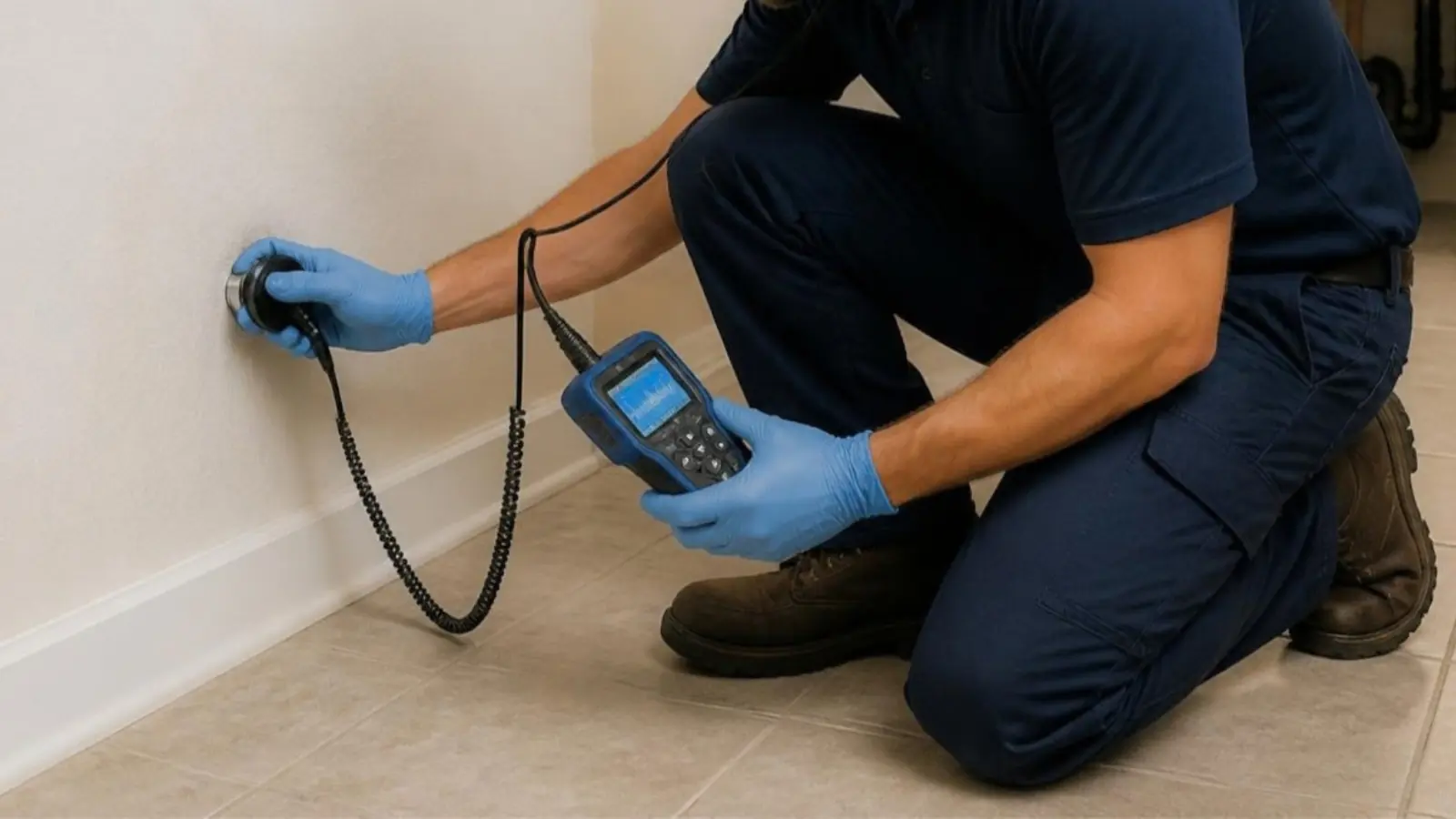
We use a moisture meter to map the wet area, a thermal camera to see temperature differences behind the surface, and a listening tool at suspect pipes. Then we shut off one fixture or one line at a time to see which one feeds the moisture. Opening the wall comes last, and the hole is kept as small as the repair allows.
Confirming that a wall is dry
People ask us to confirm a wall is dry after a repair, before painting, or during a home sale. Moisture readings and thermal imaging can show whether the area is dry right now. They cannot promise it will stay dry, and they cannot see inside a sealed cavity with perfect accuracy. We tell you what the readings show on the day and note the limits.
If the water source was a drain or a vent line instead of a supply pipe, drain cleaning or a drain repair may be part of the fix. A stain that grows only when it rains is probably a roof or window problem, not plumbing.
Under the house: crawlspace leaks
Running water you can hear from the floor above, a wet patch of soil in the crawlspace, a sagging insulation batt or a musty smell near a floor vent all suggest a leak underneath. Pipes there are more exposed to cold snaps, rodents, loose hangers and old fittings than pipes inside walls. Homes from the late 1970s and 1980s often still have some original supply lines or drain fittings down there.
We crawl the space with a light, look for dripping, corroded joints, split fittings and sagging drains, and use a listening tool on each branch. A leaking toilet seal or drain joint above can drip for months before it shows. If a drain is separating, a camera pass may be needed, which connects to our sewer inspection work.
Crawlspaces are tight and sometimes unsafe. We do not enter a space with standing water near live wiring, a sewage odor that makes it hard to breathe, or no safe path. In that case we make the area safe first, or look from access points and test by isolation.
Buried, yard and service line leaks
A soggy patch of lawn in a dry week, a low spot that stays green, a drop in water pressure or a meter that moves with the house off all point to the line between the meter and your home. Long runs, older plastic pipe and tree roots are the usual reasons. In a neighborhood with mature evergreens, roots can lean on a line for years before a joint gives.
We listen along the line, isolate sections with test plugs where access allows, and use tracer gas on lines where sound is faint. Plastic pipe is quiet, so it can take longer than metal. If the search ends at a failed service line, our water service line repair page covers repair versus replacement.
Call 811 before any digging. The utility locate service marks buried lines so nobody hits a gas or electric line while chasing water. If your question is who owns the meter box or the connection at the meter, ask your water utility which side belongs to the utility and which to you. We do not guess about that.
Irrigation and sprinkler leaks
Sprinkler lines can leak at a cracked valve, a broken head, a loose fitting or the line feeding the system, and the signs are a soggy zone, a zone that runs weakly or a meter that moves only when irrigation is enabled. Shut the irrigation supply and see if the meter stops. We can locate a leak on the pressurized side, while a damaged head or a buried control wire is often a landscaper's job.
Pool, spa and hot tub leaks
Spa and pool water loss is a different trade from house plumbing. Ask the dispatcher plainly what scope we cover for your situation before booking. We can look at the supply and drain lines that connect to the equipment, but work on the spa shell, jets, pumps or heater may need a spa specialist. We would rather tell you that on the phone than after a visit.
The equipment we use and where it falls short
- Acoustic listeningGround microphones and contact listening devices pick up the sound of water escaping under pressure. Works best on metal pipe and quiet surroundings.
- Thermal imagingShows temperature differences behind a surface, which helps with hot water leaks and wet insulation.
- Moisture metersMeasure moisture in drywall, wood and flooring so we can map how far water has spread.
- Pressure testingIsolates a line and watches the gauge. A falling needle confirms a leak on that section.
- Tracer gasA gas mix made for leak work, pushed into a line that rises through soil or slab to a sensor. Used when sound alone is not enough.
No tool finds every leak. Very slow seeps, plastic pipe, leaks under heavy slab or soil, and noise from traffic or pumps can all hide a leak from one method. We often combine two or three, and sometimes the honest answer is that we narrowed it to a section and need to open one access point to confirm. We cannot promise an exact spot to the inch.
Repair choices once the leak is found
Finding the leak is one job and repairing it is another. We tell you what we found, where, and what the repair choices are, and the repair is your decision. You can approve the fix with us, hire someone else, or handle it yourself if it is a job you are able to do.
| Option | Best when | Trade-off |
|---|---|---|
| Spot repair of the leaking joint or section | One failed fitting or short split on otherwise sound pipe | Cheapest and fastest, but nearby pipe of the same age may fail next |
| Replace the damaged run | A longer stretch is corroded or a line keeps leaking | More cutting and patching, but fewer return visits |
| Reroute through walls or attic | A leak under a slab or a buried line that is hard to reach | Less concrete work, with some drywall and paint to restore |
| Fix the fixture or valve | The leak is at a toilet, faucet, supply stop or heater connection | Simple and quick, but only if the pipe behind it is sound |
| Whole-line replacement | A buried service line is failing in several spots | Larger job, but resolves the run for years |
What a leak search costs and why it varies
We do not publish a flat figure because a quick check of one suspected spot and a full survey of a house are different amounts of work. You get a clear price before work starts, and the factors below decide where it lands.
Insurance note: sudden damage, like a pipe that bursts, is often covered. Slow leaks that went on for months often are not, and policies differ. Read your policy or ask your insurer before you call a restoration company.
Mill Creek homes and where leaks tend to start
The original plat east of SR 527 was built from 1976, with most first-phase homes and condos finished by about 1983. Water heaters in those houses have often been replaced once or twice, and some supply and drain fittings are original. If your home is that age and you have a recurring stain or a high bill, mention the year when you call so we know what pipe to expect.
Newer areas such as Town Center, which began construction in 2001, and East Gateway, which began in 2012, have more modern materials. They can still leak at a poor connection or a failed fixture seal. The Farm at Mill Creek was approved in 2019, so those homes are the newest. Whatever the age, a leak is more likely to start at a joint or fixture than in the middle of a pipe.
Western Washington is wet from fall through spring, and a damp basement after a storm is not always a plumbing leak. If water appears only after heavy rain, it may be seeping through the foundation or from poor grading. We check the plumbing first, and if it tests dry, we tell you plainly that the water is coming from outside.
Landlords, tenants, buyers and sellers
A tenant who finds a leak should tell the landlord or property manager in writing, photograph the damage and shut the water off if they can. A property manager can authorize the visit by phone, and we can coordinate with the owner. In multi-unit buildings, we work to find which unit or which shared line is losing water before anyone assumes.
Buyers and sellers sometimes want a dry wall confirmed or a high bill explained before a closing. We can test and report what the equipment shows that day. We do not issue a promise that the pipes will stay leak free. Service to nearby towns like Bothell works the same way.
Leak detection questions from Mill Creek homeowners
How much does leak detection cost in Mill Creek?
The price depends on whether we are checking one suspected spot or surveying the whole house, how easy the pipes are to reach, and how many tools the search takes. We give you a clear price before work starts. Repair and wall or floor restoration are priced separately from finding the leak.
Do you handle leak detection emergencies at night or on weekends in Mill Creek?
Yes. The 24/7 line takes leak calls at any hour, and we book same-day appointments when available. If water is actively spreading, shut off the main valve if it will close and tell the dispatcher what you see. We do not promise an arrival time, but we will tell you the plan and the price before work starts.
Can you find any leak, and can you tell me the exact spot?
Not always. Listening gear, thermal imaging, moisture meters, pressure tests and tracer gas are strong tools, but very slow leaks, plastic pipe and leaks under thick slab can still hide. We often narrow the area to a section and confirm by opening a small access point. We never promise to the inch.
Will you also fix the leak after you find it?
We find the leak and explain what it is. The repair is a separate decision with its own price, and you can approve it with us or take the findings to another contractor. If we do the repair, you hear the price first.
How do I know if the leak is inside or outside the meter?
Turn off every fixture, read the meter, and wait 30 to 60 minutes. Then shut the house main and check again. If the meter stops with the main closed, the leak is inside the house. If it keeps moving, it is between the meter and the valve.
Is a leak in the meter box my problem or the utility's?
That depends on where ownership starts and ends, and it is set by your water utility. Call them and ask which side of the meter belongs to the utility and which belongs to you. We find the leak either way.
I rent my home. Who calls, me or my landlord?
Tell your landlord or property manager first, in writing, and take photos. If they authorize a visit, they can call us or give us permission to coordinate with you. We do not repair a rental without the owner agreeing to the cost.
Can you confirm a wall is dry before I paint or sell?
We can take moisture readings and thermal images and tell you what they show that day. That is a snapshot, not a guarantee. If a reading is high, we trace the source before you close the wall.
Is my wet basement a plumbing leak?
Sometimes. If it only gets wet after heavy rain, it may be foundation seepage or grading, and a plumber cannot fix that. We test the plumbing first and tell you honestly if the pipes are dry.