
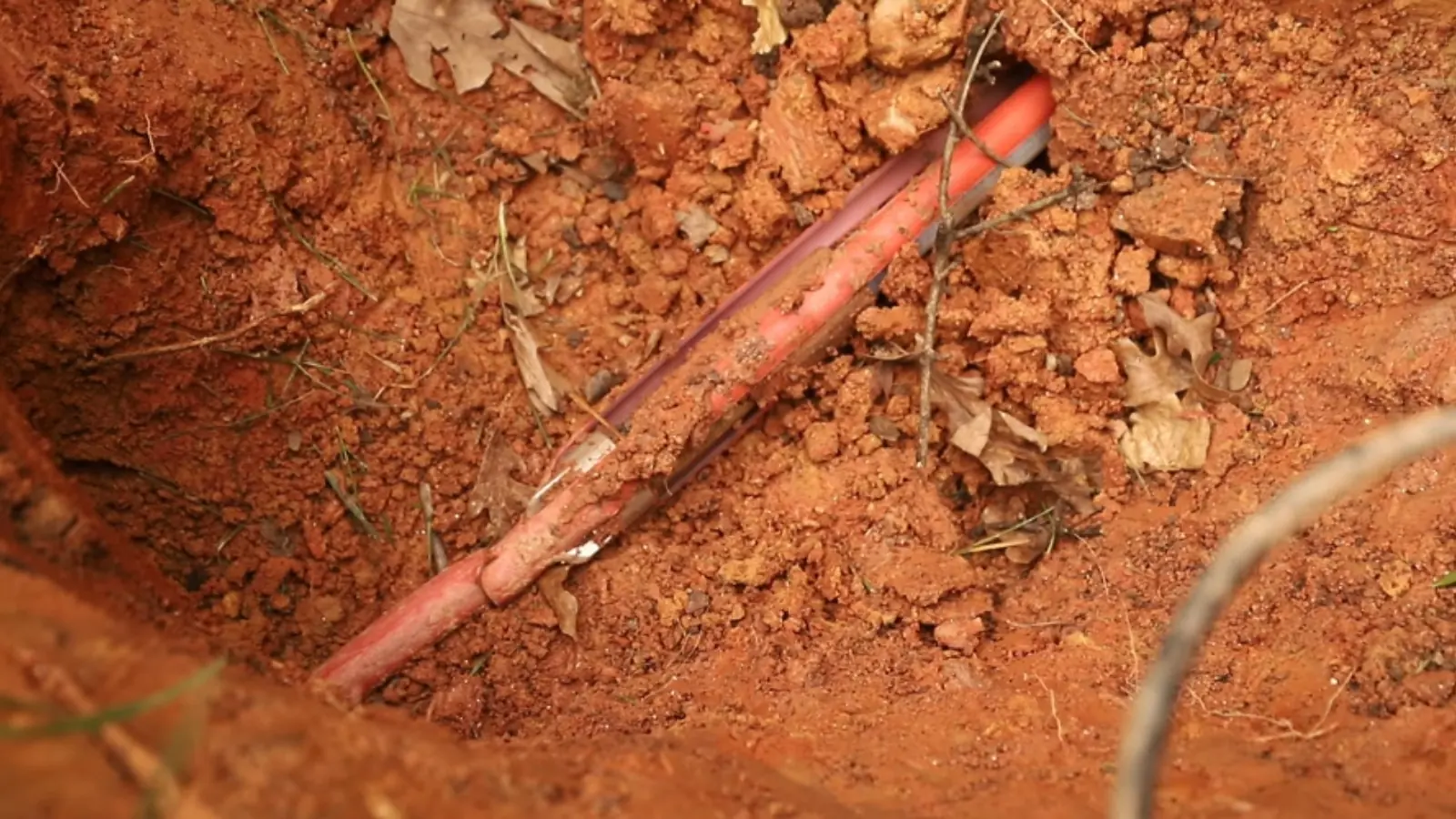
When a service line problem is an emergency
A broken service line can send a steady stream of water into your yard, undermine a driveway or walkway, and run your meter day and night. Water that surfaces near the foundation or flows into a crawlspace is urgent. So is losing water entirely, especially with children, elderly family members or a medical need in the home.
We answer around the clock, so a Saturday night break is not a reason to wait until Monday. We book same-day appointments when available, including after hours, but we do not promise an arrival time. We will tell you the plan and the price before work starts, and we explain what the water utility may need to do on its side.
Find the house main
Locate the shutoff where the line enters the house and turn it off. This stops water inside, but it will not stop a leak outside, since the break may be before the valve.
Look at the meter
With the house main closed, see whether the meter still moves. If it does, the loss is on the line between the meter and the house. Note the reading and time.
Mark the wet spot
Place a flag or stake at the soggy or sunken area, and keep kids, pets and vehicles away from soft ground.
Do not dig yet
Call 811 before any digging so buried utilities are marked. Hitting a gas, electric or fiber line is far worse than a water leak.
Service line leak between the meter and the house
This is the repair people call about most. Signs include a wet or unusually green patch of ground, a sunken spot in a lawn or driveway, a hissing sound near the entry point, a falling pressure reading and a bill that suddenly doubles. Sometimes a leak never surfaces at all, because the water drains into gravel or soil.
We confirm the leak with a meter test, then trace it. Our leak detection methods, including acoustic listening and tracer gas, narrow the break to a section of pipe. Plastic lines are quiet, so they can be harder to hear than metal, and we tell you honestly if we narrow it to a stretch instead of a point.
Older pipe, shifting soil, tree roots and joints made with worn fittings are the usual causes. In neighborhoods with mature evergreen and broadleaf trees, roots can lean on a buried line for years. The first-phase Mill Creek homes, built from 1976 and mostly finished by about 1983, may have original service lines that are now over four decades old.
Low water pressure
Low pressure has several causes, and the service line is only one of them. A partial leak in the buried line, a partly closed or failing main valve, a clogged pressure regulator, corroded interior pipe or a single clogged aerator can all weaken the flow. We start by checking whether the problem is the whole house or one fixture.
- Compare fixtures. If only one faucet is weak, the cause is local, such as a clogged aerator or a worn cartridge. If every fixture is weak, the issue is upstream.
- Check the main valve. A gate valve that is only partly open will restrict flow. Make sure it is fully open.
- Look at the meter. A meter moving with all fixtures off suggests a leak, which can also drain pressure.
- Call us. We test pressure with a gauge at a hose bib and look at the regulator, the valve and the incoming line.
We do not state what pressure your street delivers. If the low pressure follows a utility outage or street work, ask your water utility about conditions in your area. If the gauge reads normal at the meter but poor in the house, the problem is on our side of the line, and we can usually find it.
No water at the house
When the water goes off completely, start with the simple checks. Look at neighbors and see if the outage is wider. Check whether the main valve was bumped closed and whether the meter box is flooded or the meter dial is stuck. Make sure a bill or account hold is not the reason, since the utility may have turned service off.
If the neighbors have water and you do not, a break in your line, a failed valve or a frozen section after a cold night are all possible. Water may still reach the house but be blocked by a clogged pressure regulator or a failed pump on a private system. A plumber can isolate the problem by testing at the meter, the main and the first fixture.
Repair or replace the service line
A spot repair is the right call when one joint or a short section has failed and the rest of the line is sound. Replacement makes more sense when the pipe is old, has leaked more than once, is a material that is known to age poorly, or has been repaired several times. We explain what we see and let you decide.
| Option | Best when | Trade-off |
|---|---|---|
| Spot repair with a coupling | One failed joint or short split in good pipe | Lowest cost and fastest, but the next weak spot may be nearby |
| Replace a long section | Several leaks or corrosion along part of the run | More excavation, fewer return visits |
| Full replacement meter to house | Old, brittle or repeatedly repaired line | Highest cost now, and it ends the guessing for decades |
| Trenchless or pull-through methods | Lawn, patio or driveway you want to protect | Depends on soil, depth and existing pipe, and not suited to every lot |
| Open trench | Shallow or simple routes with clear ground | Surface restoration needed after the pipe is in |
Permit rules vary, so ask the building department for your address before a replacement. We tell you what we can do on our side of the line, and what only the water utility can touch.
Long private runs and townhouse lines
Some lots have a long private run between the meter and the house, and a longer run is the harder case. A long line means more joints, more soil movement and more places for a leak to hide. Searching and repairing takes longer, and the cost of a full replacement rises with the footage.
Townhomes and condos can have shared or neighboring lines that complicate things. If your line crosses a neighbor's lot or a shared easement, tell us up front, because it affects who must approve the work. A homeowners association may also need to be notified before digging.
Suspected lead service line
Some older service lines in the country were made of lead in earlier decades. We cannot tell you the material by looking at a house. The pipe material can be verified by exposing the line near the meter or the house entry and checking it. Ask your water utility whether it keeps records, and check your latest water quality report.
We do not make health claims about lead, and we are not a testing lab. If you want the pipe identified before you plan a replacement, say so on the call and we will tell you what a visual check can and cannot show.
Well-to-house lines on the rural fringe
A few properties around the edges of the area are on wells instead of a city water system. A leak or break in the line from the well to the house, or in the line to an outbuilding, is something we can discuss, but scope varies. Pump, pressure tank and water quality work may call for a well specialist. Ask the dispatcher whether your setup is within what we handle.
Who owns what at the meter
People often ask whether the meter box and the pipe next to it belong to them or the utility. That is set by your water utility, and the answer differs from place to place. Ask your water utility which side of the meter is theirs and which is yours. We then work on the part that belongs to you and tell you when the utility needs to be called.
The City of Mill Creek's utilities page lists two water and wastewater providers, Alderwood Water and Wastewater District and Silver Lake Water and Sewer District. Which one serves a given address depends on where the home sits, so check your latest bill or call the provider to confirm. Then ask where its responsibility ends and yours begins.
Cost factors for a service line job
What drives the price of a service line repair
No two yards are alike, so we do not publish a fixed figure. We assess the line, then give a clear price before work starts.
Insurance note: sudden damage may be covered, while wear and slow deterioration often are not. Some policies have optional service line coverage. Read your policy or ask your insurer.
We also help nearby towns with the same kind of service line work. Related to this page, a failed line is sometimes the first sign that the rest of the pipe is aging, and repiping the house is a separate decision you can make later.
Water service line questions from Mill Creek homeowners
How much does water service line repair cost?
It depends on the length, depth, what is on top of the line, pipe material and repair method. We give a clear price before work starts. Surface restoration, permits and utility fees can be separate.
Do you handle water service line repair emergencies at night or on weekends in Mill Creek?
Yes. The 24/7 line takes calls for line breaks, flooding yards and no-water situations. We book same-day appointments when available, but we do not promise an arrival time. We will explain the plan and the price before work starts.
How do I know the leak is in my service line?
Close the house main and watch the meter. If the dial still moves, water is escaping between the meter and the shutoff. A wet patch in the yard, a sunken spot or a drop in pressure supports that.
Can you find the leak without digging up the whole yard?
We use listening equipment and sometimes tracer gas to narrow the location first, so digging is limited to the right spot. We cannot promise an exact point on every line, especially plastic pipe.
Should I repair or replace my line?
If one joint failed in otherwise good pipe, a repair is reasonable. If the line is old, has leaked before or is corroded in several places, replacement often costs less over time. We show you what we find.
Can you tell if my service line is lead?
The pipe material can be verified by exposing and checking the line. We do not make health claims. Ask your water utility about its records and read your latest water quality report.
Is the meter box my responsibility or the utility's?
Ask your water utility which side of the meter belongs to them. We handle the part that is yours.
Do I need to call 811 before you dig?
Yes, anyone digging should call 811 first so buried lines are marked. Tell us if you have done that, and we will confirm the marks before the work.
I own a rental. Can you coordinate with my tenant?
Yes. Give us the tenant's contact and your approval for the price, and we schedule around their access and tell you what we find.