
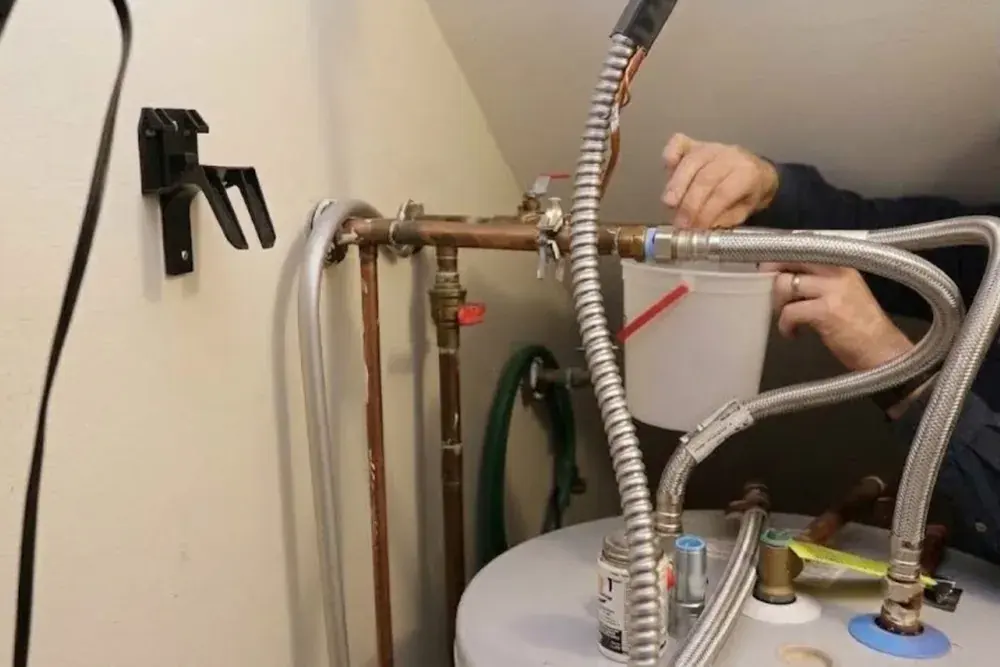
Cold shower, wet floor or both: what usually went wrong
People call us with a handful of the same pictures. A bucket under the tank that keeps filling. A pan with an inch of water in it. Hot water that lasts two minutes instead of twenty. A gas unit with no flame, or an electric one that trips its breaker the moment it heats.
Each picture points to a different part. A slow drip from a pipe fitting on top is a cheap repair. Water running out from under the jacket usually means the steel tank has rusted through, and no part can fix that. Telling those two apart is the first job on any visit.
A heater that makes popping or rumbling noises is usually carrying sediment on the tank floor or on its elements. That is a service problem, not an emergency, though it can shorten the life of the unit if ignored.
When a leaking water heater is an emergency
Treat it as urgent if water is spreading across a floor, reaching a wall, a furnace, a panel or a stored box, or if the leak is more than a slow drip. Same-day service is the goal, and we take calls at night and on weekends because a tank holds 40 to 50 gallons that can empty fast.
Smell gas? Leave first.
If you smell gas near a gas water heater, do not flip switches, do not look for the source and do not try to relight anything. Leave the building, then call 911 or your gas utility from outside. Call us after the area has been cleared and the utility says it is safe.
Stop the water in.
Close the cold supply valve on the pipe above the heater. A quarter turn lever closes fast, an old round handle may need both hands, and some are stuck. If yours will not move, shut the main valve for the house instead.
Cut the power or fuel.
For electric units, turn off the double breaker that feeds it. For gas units, set the gas control to off or pilot. Never touch the unit with wet hands or while standing in water.
Move what can be moved.
Lift boxes, rugs and tools off the floor. A garage or closet floor can hide a pool under stored items for hours before anyone sees it.
Photograph before you mop.
Take pictures of the unit, the label with its model and age, and the water on the floor. Your insurer may ask for them, and we use the label to look up parts.
If water has reached an outlet or the electrical panel, stay out of the room and use the breaker only if you can reach it from a dry spot. Otherwise tell the dispatcher when you call and we will say what to do next.
No hot water: the quick checks and the real causes
No hot water splits into a short list of causes. On electric units it is a tripped breaker, a failed upper or lower heating element, or a bad thermostat. On gas units it is a pilot or igniter that will not light, a dirty burner, a tripped thermal cutoff or a thermocouple that has worn out.
Two checks cost nothing. Look at the breaker panel for a tripped double breaker. On a gas unit, look at the control for an error light or a pilot window. If the breaker trips again right after you reset it, stop. That points to a shorted element or wiring, and resetting it repeatedly is not safe.
Callers often ask us whether no hot water means the heater is finished. Often it does not. A single element or thermostat is a modest part on a tank in good shape, while the same fault on a tank in its second decade might be a reason to look at the table below.
Gas heaters: pilot, igniter and flame problems
A gas tank that goes cold is usually asking for one of three things: a clean burner, a new thermocouple or flame sensor, or a new gas control valve. Newer units use an electronic igniter instead of a standing pilot, and a failed igniter looks exactly like a dead heater.
We can relight a pilot when the unit is in good condition and the cause is understood, following the steps printed on the manufacturer label. We will not talk you through relighting over the phone if you smell gas or if the flame keeps dying, and neither should anyone else.
Soot, yellow flame or a scorched look around the draft hood are signs of poor combustion or a blocked vent. That is a safety problem, and we will usually want the unit off until it is looked at in person.
Electric heaters: elements, thermostats and tripped breakers
Most residential electric tanks have two heating elements, each with its own thermostat. If you get a little hot water that runs out quickly, the lower element is the usual suspect. If you get lukewarm water all the time, think upper thermostat or element.
Testing an element means isolating the power and reading resistance with a meter, then replacing the part and refilling the tank. It is an ordinary repair on a healthy tank. It is also work with a 240 volt circuit, so we do not recommend DIY on it.
A scaled element can fail again within a couple of years if the tank is full of sediment. When we pull one, we look at the tank floor and tell you if a flush would help.
Hybrid heat pump water heaters: what we can and cannot tell you up front
Heat pump water heaters pair a tank with a compressor and fan on top, and they are showing up in more Mill Creek garages and utility closets. Fault codes, a fan that runs but gives little heat, or a tank that falls back to its backup elements all bring calls to our line.
Not every plumber services every brand, and manufacturers sometimes require their own diagnostic tools or approved service steps. Ask the dispatcher whether your specific brand and model is something we service before anyone drives out, and have the model number from the label ready. If it is not, we will say so rather than guess.
Fault codes, flashing lights and relight-tonight requests
A stainless or condensing unit that flashes a code is telling you which sensor or circuit it distrusts. The manual lists what each code means, but the code is only a starting point. A flame sensor code can come from a dirty sensor or a clogged vent, and the fix differs.
If you just want hot water tonight, say so when you call. Some faults can be cleared and tested in one visit, and some need a part we will have to order. We will tell you which kind yours is before we start the clock.
For a unit that has tripped on a safety device such as an over-temperature cutoff, we want to find out why before resetting it. Resetting without a cause tends to bring the same fault back by the next day.
How we find the cause
We start by reading the data plate for fuel, model, size and age. Then we look at the supply and outlet lines, the relief valve discharge, the drain valve, the anode rod port and the gas or electrical side. A dry paper towel run along fittings shows seep that is hard to see.
For electric units we use a multimeter to test elements, thermostats and continuity. For gas units we use a manometer to check gas pressure and a combustion check on the flame. A moisture meter on the wall and floor around the tank shows how far water has travelled.
You get the finding and the price before we replace anything. If the answer is that the tank is finished, we say that at the same point, and you decide.
Repair or replace: a simple way to decide
Age and leak location decide most cases. Tanks vary a lot, but a tank in its mid-teens or beyond is closer to the end than the beginning, while a younger tank with a bad part is usually worth fixing.
| Situation | Usually repair | Usually replace |
|---|---|---|
| Age of tank | Under about 10 years, no rust on the base | Mid-teens or older, especially if it has been repaired before |
| Where the water is | Pipe fitting, drain valve, relief valve discharge or supply connection | Water coming from the bottom or seams of the tank itself |
| Heating problem | One element, thermostat, igniter or thermocouple | Several parts failing close together, or a corroded gas valve |
| Repeat failures | First failure in a long time | Second or third repair in a short stretch |
| Sediment and rumbling | Tank still sound, flush and new anode may restore it | Heavy scale with a rusty drain or rust-coloured hot water |
| Your plans | Moving soon and tank is healthy | Staying put and want to avoid a second flood |
If the answer lands on the right-hand column, a water heater replacement often costs less than paying for a repair on a failing tank and then a replacement a few months later. We will tell you when we think that applies.
Anode rods, flushing and keeping a good tank going
The anode rod is a sacrificial metal rod inside the tank that corrodes so the steel does not. When it is used up, the tank starts to rust instead. Swapping a spent rod early can add years to a sound tank, and it is a sensible question if the unit is in the middle of its life.
A stuck rod, a low ceiling above the tank or a leaking tank can make the job impractical. Some tanks have no clearance to pull a rod at all. We will tell you if yours is one of them.
A flush clears loose sediment, and it is worth doing on a schedule that suits your water and your tank. Ask your water utility or check your latest water quality report if you want to know more about what is in your supply.
Mill Creek homes, earthquakes and older tanks
Much of the original plat was built from 1976 through about the early 1980s, so many of those houses and condos are on a second or third water heater by now. A tank that old in a closet that has never been checked is a leak waiting for a bad moment.
Western Washington is earthquake country, and tank water heaters are commonly strapped to the wall so they do not tip and tear the gas or water lines. Check yours. If the straps are loose, rusted or missing, tell us on the visit. We can discuss strapping, and for rules on your address, ask the building department.
Newer parts of the city, such as the Town Center area and the East Gateway and Farm at Mill Creek homes, are more likely to have newer tanks and sometimes heat pump units. Different era, different questions.
What drives the price of a water heater repair
What changes the cost of a repair
We give you a clear price before work starts, and it depends on what the diagnosis finds. These are the things that move the number.
Insurance notes: sudden damage, such as a tank that fails and floods a room, is often covered, while slow leaks over time often are not. Read your policy or ask your insurer. Call the 24/7 line and ask for the service-call terms for your visit before we dispatch.
Landlords, property managers and rental units
If you manage a rental, tell us the unit number, who has keys and who can approve the repair. Tenants calling about a cold shower sometimes cannot authorise work, and we will not start work until someone who can does. A text with the address helps the dispatcher.
For a building with several units, ask whether a single heater feeds the whole stack. That changes how fast the problem spreads and who has to be told.
Water heater repair questions
How is a water heater repair priced?
You pay for a service visit, the parts and the labour to fit them. The part and how hard it is to reach drive most of the difference. We give a clear price before work starts, and a night or weekend call is priced for that hour.
Have the model number and age ready. They help us price accurately on the phone and bring the right part.
Do you handle water heater emergencies at night or on weekends in Mill Creek?
Yes. The 24/7 line takes calls at any hour, and we aim for same-day service when available, including evenings and weekends. We cannot promise an arrival time, because it depends on what is already open and where the technician is.
While you wait, close the cold supply valve above the tank and switch off power or gas to the heater.
Can you repair a leaking tank?
It depends where the water comes from. A leak at a fitting, a drain valve or the relief valve discharge is usually repairable. Water coming from the tank body is a failed tank, and the honest answer is that no repair will hold.
In that case we can talk about replacing the unit.
I have no hot water. Is it the heater or something else?
Check the breaker on an electric unit and the pilot or error light on a gas unit. If those look normal and the water is cold at every tap, the heater is likely at fault. If only one tap is cold, the problem may be a mixing valve or a fixture cartridge.
Can you relight my pilot tonight?
Often yes, if the unit is in good condition and there is no gas smell. We follow the manufacturer label, and we find out why it went out. If you smell gas, leave the building and call 911 or the gas utility first.
Do you work on heat pump or hybrid water heaters?
Ask the dispatcher about your brand and model. Not every make is something we service, and some need manufacturer tools or approved steps. We would rather tell you up front than send someone who cannot finish the job.
Can I use hot water while I wait?
If the heater is leaking, no. Shut off the cold supply and the power or gas. If it just has no hot water and no leak, there is no harm in leaving it off until we arrive.
Do you work in Bothell and other nearby towns?
Yes, we serve Mill Creek and nearby towns, including Bothell. Call the 24/7 line and give your address so the dispatcher can tell you what is possible today.