
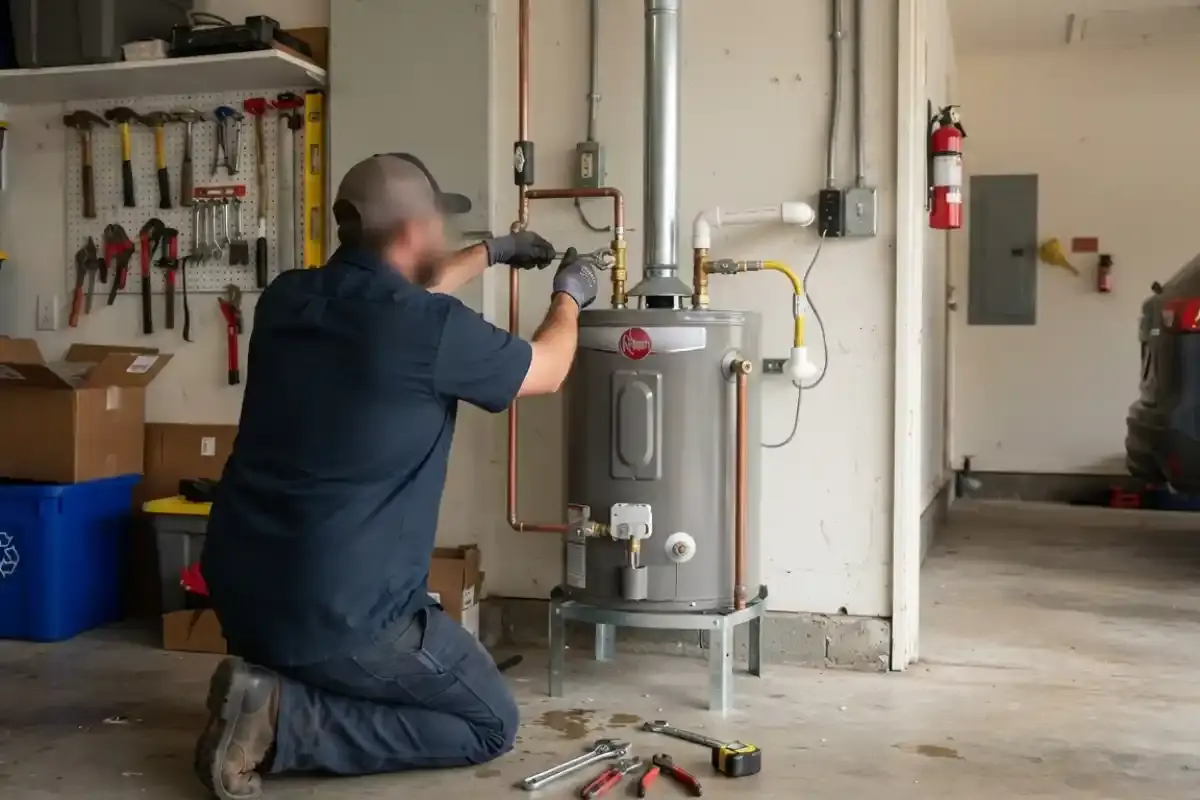
You bought the heater. Now who hooks it up?
Plenty of owners buy a unit from a big box store or online and then find that nobody wants to connect it. Calls like that are common. We can often install a unit you supply, but we want to check it first.
Tell the dispatcher the make, model, fuel and size, and ask whether it suits your venting and space. A gas unit bought for a house with no gas line, or a tall tank for a low closet, will not fit no matter who installs it.
Customer-supplied unit: what we can and cannot promise
When you supply the heater, we install it but we did not select it, so we cannot vouch for the unit. If it arrives damaged, is the wrong fuel or fails early, the manufacturer or seller is the first call. Labour terms are separate and we state them in the quote.
Warranty terms vary by manufacturer, and some require installation by a licensed professional or specific parts. Read the paperwork before you buy, and keep the receipt and the model plate photo.
If you are still choosing, we can quote a unit we supply, and then one installer is responsible for the whole job.
What a normal install includes, step by step
- Shut off and drain the old unit. Water, power or gas are isolated, and the tank is drained to a safe point.
- Set the new tank. It goes on a level base, over a drain pan if the space calls for one, with room for access to the drain valve and controls.
- Connect the water. New flexible connectors or pipe, a shutoff valve and, where discussed, an expansion tank on the cold side.
- Connect power or gas and vent. Electric units need a suitable circuit. Gas units need a gas connection and a vent that fits that unit.
- Fill, purge and test. We fill the tank, bleed air at a hot tap, check every joint for seep and run the unit through a heating cycle.
What your quote includes will vary, so ask. Haul-away of the old tank and any permit are things to ask about, not things we assume are included.
Who does the gas line and the electrical circuit
Be clear on this before the day. We connect the heater to an existing gas line or circuit that is ready for it. If a new gas branch, a bigger gas line or a new 240 volt circuit is needed, that may involve other licensed trades or additional steps, and we tell you when we quote.
Adding a circuit is electrician work in most cases. Extending a gas line may be ours or someone else's depending on the job. We say who does what up front so you are not surprised with a delay on installation day.
Never try to run a new gas branch or wire a 240 volt heater yourself.
Expansion tank and drain pan: topics to talk through
An expansion tank gives heated water somewhere to go when the system is closed. Whether your house needs one depends on how your water supply is set up. We bring it up on installs and explain why we suggest it or not, without claiming a rule applies.
A drain pan under the tank catches slow leaks and a drain line can carry the water away. They matter most for closets, upper floors and condos, where a leak ruins something fast. Ask what is included, and what a pan would add.
Strapping, venting and where the tank sits
Western Washington is earthquake country, and tank water heaters are commonly strapped to the wall. When we install, we talk through strapping, because a tank that tips can tear gas and water lines. Rules vary, so ask the building department what applies at your address.
Venting is the other big question. Gas units need a vent that matches the unit, whether into a chimney or out a side wall, and the right slope and clearances. A vent that does not fit the new unit is the most common reason a planned install turns into two visits.
A heat pump tank needs clearance and airflow rather than a flue, and a condensate path. We check the space before it gets delivered.
Installs here follow the state plumbing code, which is based on the Uniform Plumbing Code (UPC). Ask the building department which permit and inspection steps apply at your address before work starts, since that office decides.
Moving a water heater or installing in new construction
Relocating a heater means new water lines, a new vent or circuit, and sometimes a new drain. People do it to free a closet, move a tank out of a bedroom wall or put it nearer the fixtures it feeds. A shorter run to the kitchen and bath saves waiting for hot water.
For new construction and remodels, we work to your plans and your general contractor's schedule. Mill Creek still has newer homes going up, and new builds often use heat pump or tankless units that need rough-in work early. Ask us during framing, not after drywall.
See plumbing installation for other fixtures and rough-in work.
A new water heater that does not heat
A brand-new unit that stays cold is more often a setup issue than a bad heater. Check these before calling, and stop at any step that involves wiring or gas.
- Electric: is the breaker on, and did the installer turn on the upper and lower thermostats?
- Gas: is the gas valve open and the control set to on or pilot as the label shows?
- Is the cold supply valve fully open, and has the tank filled?
- Is there any error light or code on the unit?
- Did air get trapped in the lines, so the hot tap sputters?
If it still does not heat, call the installer first. If we installed it, call the 24/7 line and tell us what you checked. If another company installed it, we can diagnose the problem, and we will tell you if it is a fault with the unit itself.
How a planned install compares with a replacement
| Question | Planned install | Replacement after a failure |
|---|---|---|
| Timing | You choose a day that works | As soon as stock and schedule allow |
| Unit choice | More time to choose size and fuel | Often what is available |
| Prep | Venting, circuit and space can be sorted first | Prep happens on the day |
| Customer-supplied unit | Possible, after we check it | Possible, but delays are likelier |
| Typical cost drivers | Venting, circuit, access, extras | The same, plus after-hours work if needed |
What drives the price of an install
What changes the cost of an install
A planned install is easier to price than an emergency, and these are the factors that move the number.
Insurance does not usually cover a planned install. If a failed heater caused water damage, that is a different claim, so ask your insurer. Call the 24/7 line for a clear price before work starts.
Mill Creek homes and what we check first
Homes from the late 1970s and 1980s in the original plat often have closet heaters in small utility rooms with older venting. Before we quote, we ask what fuel you have, where the vent runs and how old the surrounding pipe is. Some homes have older supply pipe, and a plumber can identify it on site.
Town Center area condos and newer builds can have different limits, such as no space for a tall tank or a shared drain. Tell us the building type when you call. We also install for owners in Bothell and other nearby towns.
Water heater installation questions
How is a water heater installation priced?
The price covers the labour, the parts that connect the heater, and any venting, gas, electrical or access work your site needs. If you supply the heater, it is not in our price. We give a clear price before work starts.
Can you install a water heater I bought myself?
Often yes, after we check the model, fuel and space. We install it, but we did not choose it, so unit defects go back to the seller or manufacturer. Warranty terms vary, so read the paperwork.
Do you do same-day installs?
Sometimes, when available. If your heater has already failed, ask about replacement, which we prioritise. For a planned install, we usually schedule around venting and prep.
Does the quote include haul-away and the permit?
Ask, and get the answer in writing. Do not assume either is included. Permit rules vary, so ask the building department what applies to your address.
Can you move my water heater to another room?
Usually, yes, though it involves new pipe, a vent or circuit and sometimes a drain. We review the new spot before quoting, and we say if it is a poor location.
Can you do the gas line or electrical circuit too?
We connect to existing, ready lines. A new gas branch or a new 240 volt circuit may involve other trades, and we tell you who does what before the day.
Can you fix a heater that was installed by someone else and will not heat?
We can diagnose it, and we tell you whether the cause is setup, a part or the unit. Call the 24/7 line and describe what you checked.
Do you install in new construction?
Yes, to the plans and your contractor's schedule. Early talk about heat pump or tankless units helps, because the rough-in is different. See tankless water heaters for that option.