
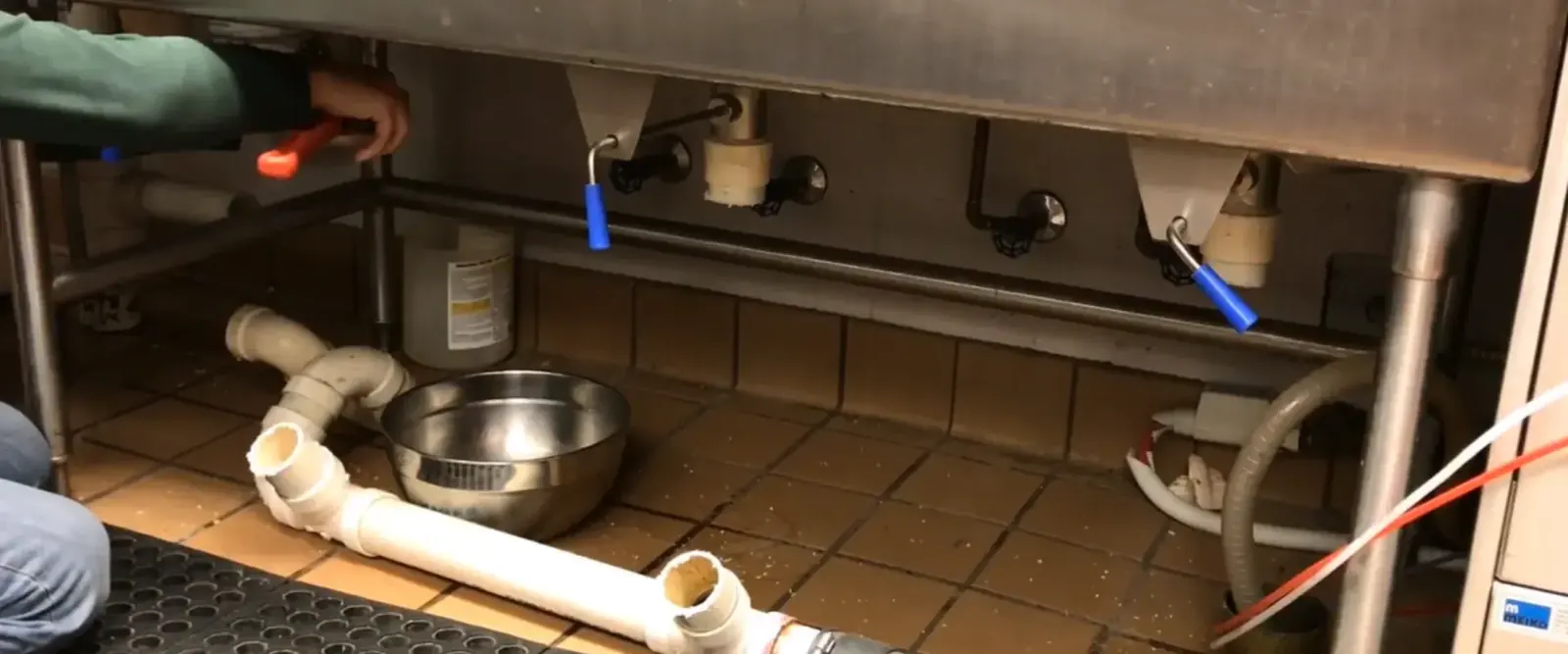
When a commercial leak or overflow is an emergency
A business loses money when the water is on. Urgent situations include a pipe leaking above a ceiling in an occupied space, a floor drain overflowing in a kitchen or back of house, and a restroom flooding. A grease trap backing up into the kitchen counts too, as does any leak that threatens stock, electrical rooms or a neighbor's unit. We offer same-day appointments when available, and the 24/7 line takes after-hours calls.
Do not wait until morning for a flooding floor. Water spreads under flooring, through shared walls and into the suite below, which turns one tenant's problem into several. If the leak is a single burst pipe, burst pipe repair covers the repair itself, and the dispatcher will sort out which team you need.
Find the shutoff.
In a stand-alone building, look for the main valve near the water meter or where the line enters. In a shared building, ask the manager or landlord.
Keep people safe.
Clear customers and staff from wet floors near equipment, coolers and panels. Do not use electrical gear standing in water.
Stop using drains.
Pause dishwashers, floor sinks and restrooms on the affected line to avoid pushing more water in.
Gather the facts.
Street address, suite number, who can authorize work and whether the building has a fire sprinkler system, which we do not work on.
What we need to quote a commercial job
We cannot quote commercial work from a one-line description. To scope it, we need the property type, whether the building is occupied, where the problem is and how we get to it. A restaurant behind a kitchen line, a second-floor suite with a locked tenant space and a bare warehouse have very different access. Tell the dispatcher who authorizes the work and who pays.
We do not give a guaranteed number on the phone. Commercial leak detection, drain work and new-construction bids are scoped, then priced. Some jobs we may decline or refer out, such as fire protection mains, large boiler work or anything outside a plumber's scope.
Commercial leak detection
Leaks in a business can hide for weeks: in a slab under a retail unit, above a ceiling in an office, in a buried line to a parking lot or behind a restaurant's walls. Callers often start with a water bill that jumped, a meter that spins with the building closed or a notice from the water utility. We use acoustic listening equipment, thermal imaging, pressure testing and moisture meters, matched to the problem.
We cannot promise to find every leak, or to pinpoint one within an exact distance, and detection gear works best when we can isolate sections of pipe. If a buried line is involved, see leak detection for how the process works, and water service line repair if the pipe from the street to the building is the fault.
Grease trap cleaning and pumping
Restaurants, cafes and food-prep spaces produce fats, oils and grease that collect in the trap. Left too long, the trap overflows or sends grease into the building's drain line, which causes slow sinks, bad smells and kitchen backups. We pump out and clean traps and interceptors, and we look at the baffles, lids and gaskets while the trap is open.
How often depends on how much the kitchen cooks and how large the trap is. The right schedule comes from looking at your trap, not from a rule of thumb. Pumping does not fix a broken pipe or a sagging line, so if a trap fills quickly after service, we recommend a camera inspection of the line beyond it. See drain cleaning for kitchen line clogs.
Backflow testing
A backflow assembly is a valve that keeps dirty water from flowing back into the drinking supply. Commercial buildings, irrigation systems and some fire lines have them, and the water utility sends an annual test notice. If the test is missed, the utility may lock off the irrigation or the service. That is a bad surprise on a hot week with landscaping to keep alive.
We say plainly: ask the dispatcher which backflow testing is available for your device and your utility's reporting process before you book, because requirements and certified testers vary. Bring the notice, the device location and the make if you have it, and we will tell you honestly whether we can do it or point you elsewhere.
Floor drains, lift pumps and drain grates
A floor drain that overflows in a store back room often means a blockage in the branch line, a floor sink that has not been cleaned or a lift pump that failed. Lift pumps, which move wastewater up from a below-grade restroom or utility room to the main line, are common in basement and lower-level spaces. When one fails, drains back up the moment someone washes their hands.
We also pull heavy drain grates and steel covers that have to be removed for access, whether the job is cleaning, retrieving a dropped item or getting a camera into the line. Tell us the size and weight of the cover and whether it is bolted. If the job is a floor drain in a cold space, check hydro jetting for lines that clog again and again.
New-construction plumbing
We are honest about this one: new commercial construction is a bid process, not a quick phone call. If you are a general contractor looking for a plumbing subcontractor, tell the dispatcher the project type, schedule and plan status, and we will tell you whether it fits what we take on. Large multi-unit and hotel projects may be outside our scope. For tenant improvements, smaller build-outs and fixture hookups, see plumbing installation.
Property managers, tenants and who can authorize
Many commercial calls come from someone who does not own the building. A tenant may call about a leak that comes from the unit above, and the landlord may have to approve the fix. A property manager may call for a tenant they have never met. We ask who is authorized to approve and pay before we dispatch, and we confirm the address, suite number and a contact on site.
Send the address by text if the dispatcher asks, give an access code or key contact and let us know about gate hours. If a national chain's work order is involved, tell us what the order requires. We cannot promise to accept every warranty or insurance payment arrangement, so ask before we book.
Why Mill Creek buildings have their own pressures
Commercial space in Mill Creek ranges from older buildings near the original plat to mixed-use buildings in Town Center, which broke ground in 2001. Older buildings have decades-old cast iron or galvanized drain and supply lines that are more likely to leak at joints. Newer mixed-use buildings stack retail under apartments, so a leak in one suite often shows in another. Know where your shutoffs are before a night call.
Which commercial service fits
| Situation | What we do | What we need from you |
|---|---|---|
| Water on the floor after hours | Dispatch, locate the source, stop the leak | Address, suite, shutoff access, who authorizes |
| Water bill or utility leak notice | Leak detection survey | Meter location, building size, past bills |
| Grease trap full or smelling | Pump and clean, check baffles | Trap size and location, last service |
| Annual backflow notice | Ask the dispatcher what testing is available | The notice, device location, deadline |
| Floor drain overflow | Clear the line, inspect the lift pump | Floor type, drain size, any recent changes |
| New build or remodel bid | Scope review, bid if it fits | Plans, schedule, general contractor contact |
What affects the price of a commercial job
How commercial plumbing is priced
Commercial jobs are scoped first, then priced. You get a clear price before work starts.
Sudden water damage from a burst pipe is often covered by commercial property insurance, while a slow leak found during routine upkeep often is not. Check your policy or ask your insurer, and keep photos of the damage.
Storm drains and cast iron pipes
Storm drain cleaning and cast iron pipe repair come up often in older buildings. Storm drains in parking lots fill with silt and leaves after wet months, and catch basins on private property are usually the owner's responsibility. Cast iron drain pipes can be patched or replaced in sections. Ask the dispatcher whether your case fits before booking.
Commercial plumbing questions answered
How do you price commercial plumbing?
Commercial jobs are scoped before a price is given, because every building is different. You get a clear price before work starts. The dispatcher will ask for the property type, access, the problem and who authorizes the work.
Do you handle commercial plumbing emergencies at night or on weekends in Mill Creek?
Yes. The 24/7 line takes calls at any hour, and same-day appointments are offered when available. Floods, overflows and kitchen backups are treated as urgent. We cannot promise an arrival time, but we tell you what to shut off and what to avoid while you wait.
Do you take commercial jobs and do you need to diagnose first?
Yes to commercial work, and often we diagnose first. We cannot give a firm price for an unknown leak or blockage, but we can explain how the scoping works. Some jobs we may decline or refer if they fall outside plumbing.
Do you pump grease traps?
Yes. Tell the dispatcher the trap size, location and when it was last serviced. Interceptors that serve several tenants may need coordination with the landlord.
Can you do backflow testing?
Ask the dispatcher which testing is available for your device before booking. Bring the notice from your water utility and the deadline.
Can you remove a heavy drain grate or cover?
Usually yes. Give the size, weight and whether it is bolted, so we bring the right tools.
I manage the property. Can I call for a tenant?
Yes. We need the address, suite and a contact for access, and we confirm who can authorize and pay before we dispatch. We can coordinate with the owner.
Can you clean storm drains or fix cast iron pipes?
We clean catch basins and private storm drains in many cases, and cast iron pipe repair is common work for us. Tell the dispatcher the pipe size and what you see. Large site drainage projects may be outside our scope. Nearby areas such as Bothell are also served.