
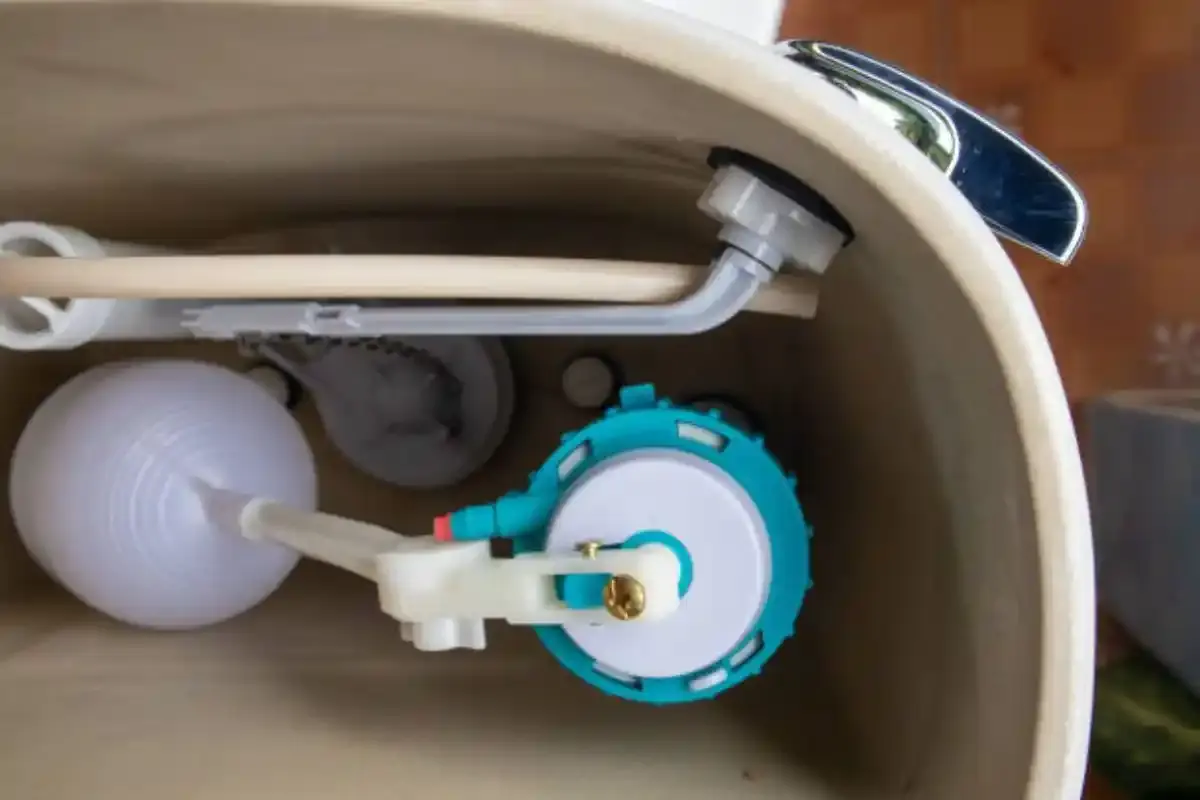
Flapper or fill valve: find the culprit first
The flapper is the rubber seal at the bottom of the tank. The fill valve is the tall assembly on the left that refills the tank after a flush. They fail in different ways, so a two-minute test saves you buying the wrong part.
Take off the tank lid and drop a few drops of food coloring into the tank. Wait 15 minutes without flushing. If color shows up in the bowl, the flapper is leaking. If the bowl stays clear but you hear hissing, or water spills into the overflow tube, the fill valve is the problem.
| What you notice | Likely part | Fix |
|---|---|---|
| Color seeps into the bowl | Flapper or flush valve seat | Replace the flapper |
| Constant hissing, bowl stays clear | Fill valve | Replace or adjust the fill valve |
| Water runs into the overflow tube | Float set too high or valve worn | Lower the float, or replace the valve |
| Tank fills very slowly | Partly closed shutoff or clogged valve | Open the shutoff, clean or replace the valve |
| Phantom flush every few minutes | Flapper | Replace the flapper |
What you need before you start
- A universal fill valve sized for your tank, or the exact brand if you want a match
- A new braided supply line, since the old one is cheap to replace while you are there
- An adjustable wrench or channel pliers
- A small bucket, a sponge, and a couple of old towels
- A flat-bladed screwdriver and a cup for the last water in the tank
Look at the tank before you buy. Most fill valves are made for tanks with a standard 1/2 inch supply opening, and heights vary, so measure from the tank bottom to the top of the overflow tube. Adjustable valves cover most sizes.
Replace the fill valve step by step
- Shut off the water. Turn the oval handle on the wall or floor, called the angle stop, clockwise until it stops. Flush once to empty the tank.
- Soak up what is left. Use a sponge to remove the last bit of water from the tank bottom. A dry tank makes the nuts easier to reach and keeps your knees dry.
- Disconnect the supply line. Unscrew the nut at the bottom of the tank that holds the line to the valve. Keep the bucket under it, because a cup of water will drip out.
- Loosen the locknut under the tank. The big plastic nut below holds the valve to the porcelain. Turn it counterclockwise by hand, or use pliers if it is tight, then lift the old valve out through the top.
- Set the new valve. Match the height to the instructions and set it so the top of the valve sits about an inch above the overflow tube. Tighten the locknut hand tight plus a quarter turn.
- Reconnect the supply line and refill. Attach the new line, open the angle stop slowly, and watch the connections. Adjust the float so the water stops about an inch below the top of the overflow tube.
- Test and look for drips. Flush a few times and dry the connections with a paper towel. A dry towel after ten minutes means you are done.
Mistakes that bring the leak right back
Overtightening is the classic one. Porcelain cracks, and a cracked tank cannot be repaired, only replaced. Tighten plastic nuts by hand and use a wrench only for a gentle extra quarter turn. If a nut still weeps, back it off and reseat the washer rather than cranking harder.
The next is a float set too high, which sends water down the overflow tube forever. Also check that the refill tube clips onto the overflow tube and does not hang down into the water. A loose tube can siphon tank water, which makes a toilet seem to leak when the new valve is fine.
Last, people reuse an old supply line with a cracked nut. Replace it. A braided line costs little compared with the repair after a burst line floods a floor.
When the old valve will not come out
Years of mineral buildup can weld a locknut to the shank. Spray penetrating oil on the thread and wait 15 minutes. If the plastic is crumbling, a pair of large channel pliers sometimes breaks the grip. Do not twist so hard that the tank flexes.
If the shutoff valve will not close fully, or it drips at the stem, stop there. Forcing an old angle stop can snap it and leave you without a way to stop the water. That is a good time to call. Our licensed plumbers do toilet repair, including swapping a stuck valve or a corroded shutoff, with a clear price before work starts.
Call also when the toilet leaks at the base, rocks on the floor, or the tank itself is cracked. Those are not fill valve problems.
A running toilet and your water bill
A silent leak into the bowl can run for weeks before you notice. To check your total, turn off every fixture, then look at your water utility's meter. If the dial moves, something is leaking, and the toilet is the first place to look.
If the toilet is fine and the meter still moves, the leak may be underground or inside a wall. Finding it takes acoustic and thermal gear, which is the work behind leak detection. Call before the damage grows.
Toilet repairs in older Mill Creek homes
Homes from the original Mill Creek plat were built from 1976 to about 1983, and many still have a toilet or two from those decades, with their original shutoff valves. Old multi-turn valves often seize after years of never being touched, so test yours before the day you need it.
Try turning each shutoff a quarter turn now and back. If one is stiff or weeps, plan a replacement before it fails mid-job. Our dispatch also covers towns near the city, and you can read more about service in Bothell if you live along the southern edge.
Toilet fill valve questions
How long does a fill valve last?
Most last roughly five to ten years, depending on how the rubber seals age. A valve that hisses, fills slowly, or will not shut off is ready to be replaced.
Is it the flapper or the fill valve if my toilet runs?
Use the food coloring test. Color in the bowl points to the flapper. A hissing tank with a clear bowl points to the fill valve. Both can be bad at once, and replacing both is inexpensive.
Do I need to shut off water to the whole house?
No. The angle stop behind the toilet isolates just that fixture. If it will not close, then you may need the main valve, and that is a sign the stop itself needs replacing.
Can I adjust the float instead of replacing the valve?
Sometimes. If the water level is simply too high, turning the adjustment screw or sliding the clip fixes it. If the valve still hisses after you set the level, the internal seal is worn, and replacing it is the real fix.
Who fixes a toilet in Mill Creek if the shutoff is stuck?
A stuck or leaking shutoff is a plumber's job because forcing it can break the stem. Call the 24/7 line and describe what you see. Same-day visits are available when the schedule allows.