
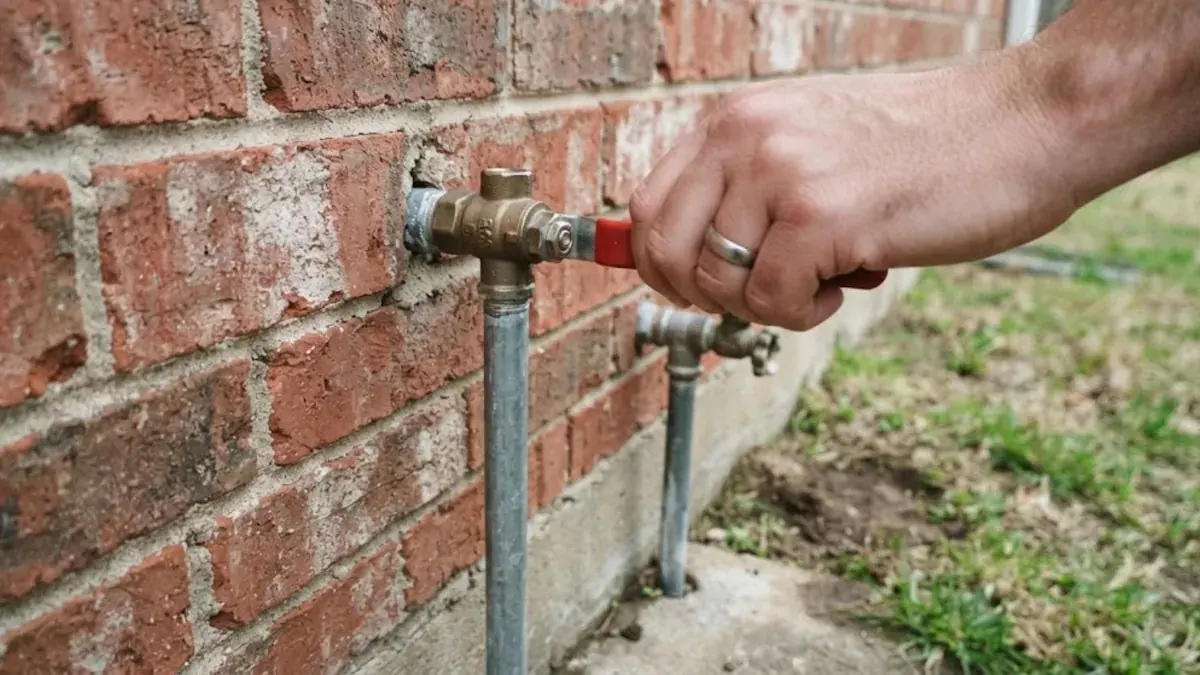
Know which kind of faucet you have
A standard hose bib has a short body that ends right at the wall. A frost-free model has a long stem, often six to twelve inches, so the valve seat sits deep inside the heated part of the wall. You can spot it by the downward tilt of the spout and the long barrel behind the handle.
Repairs differ by type. A standard faucet has the washer right behind the handle. A frost-free model needs you to pull the entire stem out of the barrel to reach the washer at the far end. Take a photo of the faucet and keep it handy for the parts counter.
| Where it drips | Likely cause | Usual fix |
|---|---|---|
| Out of the spout when closed | Worn washer or damaged seat | Replace the washer, or the stem |
| Around the handle when open | Loose or dry packing | Tighten the packing nut, or replace the packing |
| At the wall behind the faucet | Failed solder joint or cracked pipe | Stop and call a plumber |
| Spout dribbles after a freeze | Split stem or cracked body | Replace the faucet, check inside the wall |
| Hose connection sprays | Worn hose washer | Replace the hose washer |
Tools and a quick safety check
- Adjustable wrench and a pair of channel pliers
- Screwdriver that fits the handle screw
- Assorted faucet washers, a washer screw, and packing string or a packing washer
- A small bucket and a rag
- Plumber's grease for the stem threads
Close the shutoff for the outdoor line first. It is often inside the house, in a basement, crawlspace, or garage, on the pipe that feeds the faucet. If you cannot find or close it, use the main valve. Open the faucet afterward to drain the line and confirm the water has stopped.
Fix the leak at the handle: the packing nut
If water leaks around the handle when the faucet is on, the packing nut behind the handle has loosened. With the water off, give the nut a quarter turn clockwise using a wrench. Turn the water back on and look. Many leaks stop right there.
If tightening fails, remove the handle screw and the handle, unscrew the packing nut, and look at the packing. Old packing looks crumbly or flat. Wrap fresh packing string around the stem, or swap the rubber packing washer, then reassemble and test.
Fix the leak at the spout: change the washer
- Shut off the water and open the faucet. Let the line drain so no pressure remains. Keep a rag under the work area.
- Remove the handle and packing nut. Unscrew the handle screw, lift the handle off, then unscrew the packing nut. The whole stem unscrews in one piece.
- Pull the stem. Turn it counterclockwise to take it out. On a frost-free model, it is long, so pull it straight out of the barrel without bending it.
- Replace the washer. A rubber disk sits on the end of the stem, held by a brass screw. Remove the screw, then fit a new washer of the same size.
- Look at the seat. Check the brass ring inside the body. If it is scored or rough, a new washer will not seal, and the faucet likely needs replacement.
- Reassemble and test. Grease the threads lightly, refit the stem and packing nut, and open the shutoff slowly. Open the spout and let air escape, then close it and watch for drips.
Preparing for a cold snap
Disconnect every hose before the first freeze. A hose left on traps water in the faucet, and that ice can burst the pipe behind the wall, even on a frost-free model. A hose also stops a frost-free faucet from draining its stem.
Shut off the interior valve to the line if it has one, open the outdoor faucet to drain it, and leave it open until spring. Insulated covers help on very exposed walls. In Mill Creek, cold snaps happen on some winter nights, so do this in late fall rather than waiting for the forecast.
When a leak inside the wall means stop and call
Water that appears inside the house after a freeze, a wet ceiling in the garage, a stain on drywall behind the faucet, or a sound of running water when everything is off are signs of a break. Turn off the main valve and call right away.
A burst pipe can pour out a lot of water in an hour. Our licensed plumbers handle burst pipe repair on a 24/7 basis, with a clear price before work starts. Insurance often covers sudden damage like a burst pipe but often not slow leaks, so read your policy or ask your insurer.
For a stubborn hose bib that drips even after a new washer, or a seat that is worn out, a fresh faucet repair visit is more sensible than buying more parts.
Outdoor faucets in Mill Creek homes
Homes in the original Mill Creek plat, built from 1976 to about 1983, often have older standard hose bibs on exterior walls. Many were never replaced with frost-free models, so a cold snap can bite. If yours is a short-bodied type, plan to drain it each fall.
Western Washington is wet from fall through spring, and moss and damp around a faucet hide small leaks. Look at the siding below the faucet for dark staining. We also dispatch to nearby towns, and you can see our coverage near Bothell if you live on the edge of the city.
Outdoor faucet questions
Why does my outdoor faucet drip only when the hose is attached?
The hose washer inside the coupling may be worn, or the hose is pulling on the spout. Replace the hose washer first, then check that the faucet is not loose on the wall.
Do frost-free faucets need winter care?
Yes. Remove the hose and let it drain. The stem is designed to drain downhill when the spout tilts slightly down, and a hose left on defeats that.
Can I replace the whole faucet myself?
A threaded one, sometimes. Soldered ones need a torch and are best left to a plumber, especially inside a wall. Do not use a torch near wood framing.
How can I tell if the pipe split inside the wall?
Run the faucet and watch for wet drywall, a damp garage ceiling, or drops from the wall. A water meter that spins with everything off is another sign. Turn the water off and call.
Who repairs a frozen hose bib in Mill Creek after hours?
Call the 24/7 line. We can talk you through the shutoff, then set a same-day visit when the schedule allows.