
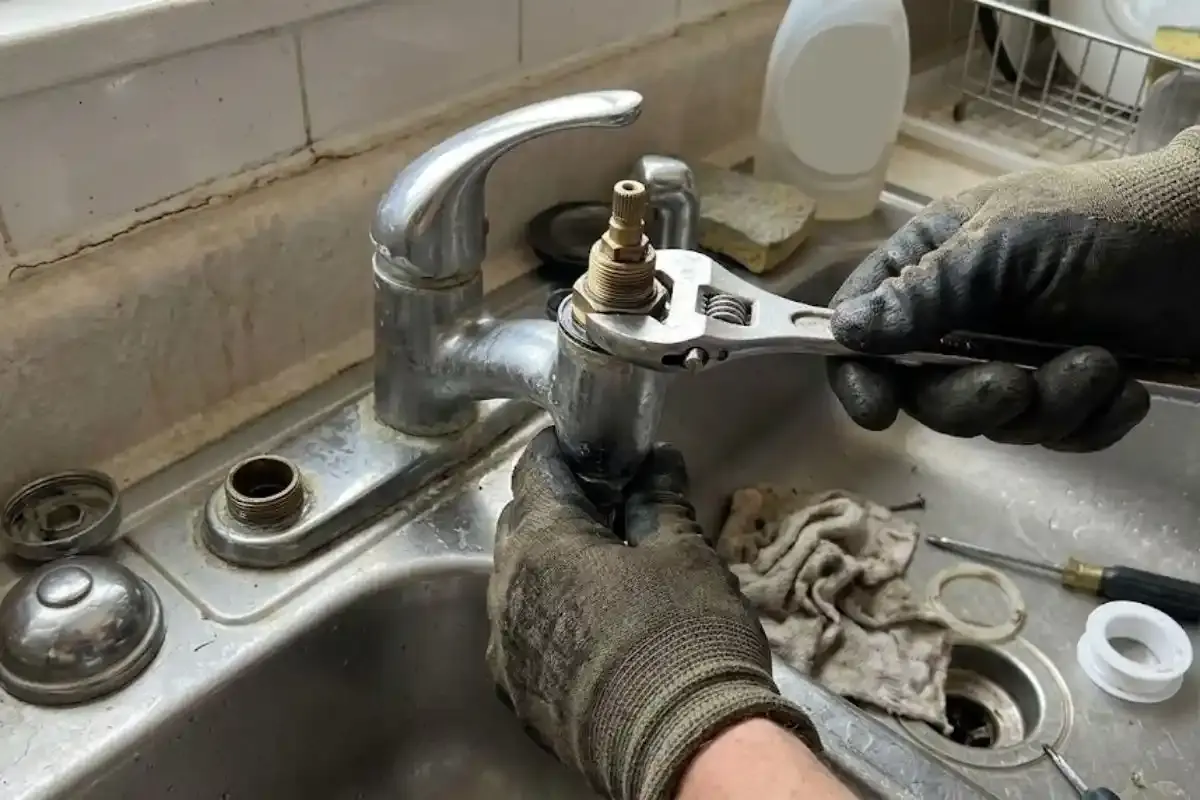
Urgent: a burst supply valve with no shutoff reachable
This is the urgent version of the job. A stop valve behind a toilet, under a sink or behind a washer cracks or blows its stem, and water comes out under pressure. The fixture shutoff cannot help because the broken part is the shutoff. The only control left is the main valve, and some houses do not have one that works.
A burst valve can put out gallons a minute. Within a half hour it can soak a ceiling below, run into a floor cavity or reach a wall outlet. If the water is coming from a pipe rather than a fixture valve, the job belongs under burst pipe repair, and the dispatcher will sort that out on the call.
Find the main.
Look in the garage, a utility closet, a crawlspace hatch or on the outside wall near the meter. Turn it clockwise until it stops.
If it will not close.
Do not use a wrench with force on an old valve. Tell us, and ask the dispatcher if the meter shutoff at the street is an option for your address.
Stay away from electricity.
Do not stand in water near outlets, power strips or a panel. Turn off power to the area only if you can reach the breaker dry.
Move what you can.
Pull rugs, boxes and cabinets away from the spray. Towels and buckets slow the damage, but they do not stop it.
What callers usually describe
The drip that keeps you awake. A kitchen faucet that sprays sideways. A tub spout that never fully stops. A shower knob that spins without turning anything because the screw stripped. A hose bib with the hose stuck on it. A cabinet floor that is wet every morning for no obvious reason. These are the ordinary calls, and most are a part, not a whole fixture.
- Drip from the spout when the faucet is off.
- Water under the sink cabinet or on the floor beside a washer.
- Handle that is loose, stripped or will not turn.
- Low flow or sputtering from one faucet only.
- Constant slow drip at a shower head or tub spout.
- Stem of a stop valve weeping when touched.
Why fixtures fail in Mill Creek homes
A home built in 1978 or 1982 on the original plat has likely seen its faucets replaced at least once, but the shutoff valves behind the walls and under the sinks are often original. Multi-turn stops that have not been used in decades seize or leak at the stem when finally closed. Exercise yours now: close and reopen each one a quarter turn, and note which ones are stiff.
Western Washington is wet, but outdoor spigots are a separate story. On cold winter nights a hose left attached traps water in the bib, and ice cracks the valve body inside the wall. The leak only shows in spring when the hose is turned on. Newer construction, such as the homes around Town Center or The Farm at Mill Creek, is more likely to have frost-free bibs, which still need the hose removed.
How we find the cause
We begin by turning the water off at the nearest working stop and drying the area. A dry paper towel held under each joint shows which connection is the weeper. For a faucet, we shut off the supply, take off the handle and inspect the cartridge, seat and O-rings. For a valve, we look at the stem packing and the body for cracks.
If the leak shows up only when a fixture is running, we test under pressure with a gauge. If you hear water inside a wall with everything closed, or the meter turns with all fixtures off, that is a different search and leak detection is the right call.
Faucet cartridges, stripped knobs and tub faucets
Most single-handle faucets run on a cartridge, a replaceable insert that controls flow and temperature. When it wears, you get a drip, a stiff handle or a temperature that wanders. Replacing a cartridge costs far less than a new faucet, if the model still has a part available. Older or discontinued faucets sometimes have no cartridge to buy, and a new faucet is the honest answer.
Tub faucets add a wrinkle. A stripped handle that spins freely, a diverter that does not hold or a spout that drips behind the tile may need the wall opened or an access panel. We tell you before we start whether a repair stays at the surface or becomes tile work.
Shower valves and showerhead leaks
A showerhead that drips after the water is off is often a worn washer or a tired cartridge in the valve behind it. A leak at the head's threads is a tape and tightening fix, unless the arm was cross-threaded earlier and the threads are damaged. If water appears on the ceiling below or the wall behind the shower is stained, stop using that shower until we look. A slow leak inside a wall does harm that nobody sees.
Outdoor spigots, hose bibs and winterizing
A hose bib that drips, a handle that spins loose or a hose fused to the fitting are all common calls. Replacement is usually quick when the bib is on an exterior wall with easy access. If the pipe runs through an unheated crawlspace, the leak may be inside the wall and the job is bigger.
Before the first hard freeze, unscrew every hose, drain the line and close the interior shutoff to the bib if your house has one. Cold snaps do not come every winter in Mill Creek, but one night can split a bib that has a hose attached. If you find a wet crawlspace after a freeze, close the main and call.
Utility sinks, dishwasher and washer valves
The small connections get less attention than they deserve. A laundry sink faucet that drips into a slow drain, a washer valve that weeps behind the machine, a dishwasher supply line that sweats or a fridge line with a loose fitting can all sit hidden for months. Washer hoses are worth replacing with braided lines if they are rubber and several years old.
Repair or replace the fixture
| Situation | Repair | Replace the fixture when |
|---|---|---|
| Dripping kitchen or bath faucet | New cartridge, seat or O-rings | Parts are discontinued or the finish is already failing. |
| Stripped tub or shower handle | New handle and screw, or a cartridge | The valve body is cracked or corroded behind the wall. |
| Leaking stop valve | Replace valve and supply line | Pipe behind it is damaged, which is a pipe repair. |
| Hose bib drips or has a stuck hose | New washer, stem or bib | Bib split from freezing or leaks inside the wall. |
| Shower head leaks | Tape the threads or swap the head | Arm is damaged or valve cartridge is worn. |
| Imported-brand fixture | Depends on part availability | Part must come from overseas and the delay costs more than a new fixture. |
Imported-brand fixtures: the honest answer
Fixtures made overseas sometimes use metric fittings, proprietary cartridges or special tools. We can usually repair one if a part exists and you can supply it or we can order it. We cannot promise to match a rare finish or fix a model the maker no longer supports. Give the dispatcher the brand and model, and we will tell you plainly whether a repair or a swap makes more sense.
What affects the price of a fixture job
How faucet and fixture repair is priced
You get a clear price before work starts. Two costs people often mix up are the trip to your home and the fixture itself, and they are priced separately.
A sudden supply failure that damages a floor is often covered by homeowners insurance, while a slow drip that rots a cabinet over months often is not. Read your policy or ask your insurer.
Before we arrive
Clear under the sink and around the fixture so we can reach the valves. If you have a replacement faucet, set it where we can see the box. Take a photo of the brand name and any model number. Tell us if the water will not turn off, because the plan changes. If a toilet valve is the leaking part, see toilet repair.
Renters should ask the landlord or manager to confirm the work. We also dispatch to nearby towns like Bothell.
Faucet and valve questions answered
How much does faucet repair cost?
You get a clear price before work starts. The trip and the fixture are separate parts of it, and parts, access and the condition of your shutoff valves decide the rest. The dispatcher can explain how it works for your situation, but we do not quote exact figures sight unseen.
Do you handle faucet and fixture repair emergencies at night or on weekends in Mill Creek?
Yes. The 24/7 line takes calls at any hour, and same-day appointments are offered when available. A broken supply valve spraying water counts as urgent, and we will tell you how to shut off the main while we dispatch. We cannot promise an arrival time.
Can you replace a faucet I bought myself?
Yes in most cases. Tell the dispatcher the brand and whether it is single-hole or three-hole, so we know what to bring for the supply lines and drain.
Can you repair a faucet from an overseas brand?
Sometimes. If parts are available and fit the fixture, yes. If the part is not stocked locally or the maker has stopped supporting the model, we will say so and discuss a replacement.
My tub knob spins and nothing happens. Is that a big job?
Often it is just a stripped handle screw or insert. If the stem inside is stripped, the valve cartridge needs to be replaced, and if there is no access panel, that may involve opening the wall. We confirm before we start.
Can you winterize my outdoor faucets?
We can drain and shut off the interior valve for hose bibs that have one, and we can replace a bib that has split. Hoses should be disconnected before cold nights. We cannot promise a split bib has not leaked inside the wall until we look.
I rent. Who can approve the repair?
The owner or property manager. If water is spraying, you can shut the main and call us, and we will confirm the work with them. Give the dispatcher their contact information if you have it.
Could a slow leak be causing my high water bill?
Yes. A faucet or valve drip is small, but running toilets and hidden leaks add up. If the meter keeps moving with everything off, see leak detection.