
What to gather first
Everything you need is already in the house. A flashlight, a few drops of food colouring, a notepad and a phone for photos. You will also need access to your water utility's meter, which sits in a ground box near the street in most neighbourhoods, or in some homes inside a wall or garage.
Check the last two bills before you start. Look at daily use, not only the total. A sudden step up on a certain date points to something that started then, such as a season change or a failed part. A slow upward creep points to a leak that is growing.
- A flashlight and gloves for opening the meter lid, if the lid is yours to open.
- Food colouring or a dye tablet for the toilet test.
- A paper towel to wipe around valves and connections.
- A phone to record meter readings and the time.
Step by step: the meter test
- Stop all water use. Turn off taps, the dishwasher, the washing machine and any ice maker. Make sure nobody flushes.
- Read the meter. Look for the small triangle or wheel, the low-flow indicator, that spins with even small flows. Write down the reading and the time.
- Wait fifteen to thirty minutes. Do not use any water at all during this period.
- Read it again. If the dial moved, or the small indicator keeps turning, water is escaping somewhere on your side of the meter.
- Close the main valve and test again. If the meter stops, the leak is inside the house. If it still moves with the main closed, the leak is before that valve, which points at the service line. Do not open the meter-side valve yourself, since that belongs to the utility.
A meter that stays perfectly still means the leak, if any, is intermittent. That can be an irrigation timer, a toilet that fills now and then, or a heater relief line. Try the test again at a different time of day.
The toilet dye test
Toilets are the most common silent leak in a home. A worn flapper lets tank water seep into the bowl all day with barely a sound. Remove the tank lid, add several drops of food colouring, and do not flush.
Wait fifteen minutes. If colour shows up in the bowl, the flapper or seat is leaking. A fix is often a cheap part that a homeowner can replace, or you can ask us about leak detection if you want the whole house checked at once. Do this for every toilet.
Outdoor and irrigation checks
Walk the yard after the meter test shows a leak. Look for patches of lawn that stay green or soggy in dry weather, a wet strip along the foundation, or a hose bib that drips when it is turned off. Check irrigation zone valves, because one stuck open can run all night.
Look in valve boxes for standing water, and turn the irrigation system off at its own shutoff while repeating the meter test. If the meter now stays still, the sprinklers are the leak. Call 811 before any digging, and do not dig around buried lines yourself.
- Hose bibs that drip or weep around the stem.
- Irrigation valve boxes holding water.
- Soft soil, moss or green strips over a buried line.
- A foundation wall that stays damp when it has not rained.
Listening in the crawlspace
With water off at every fixture, go to the crawlspace or basement and stay still. A hiss, a faint trickle or a ticking sound near a pipe means pressure is escaping. Shine your light on supply lines, joints and hanging insulation for drips, rust stains or wet soil.
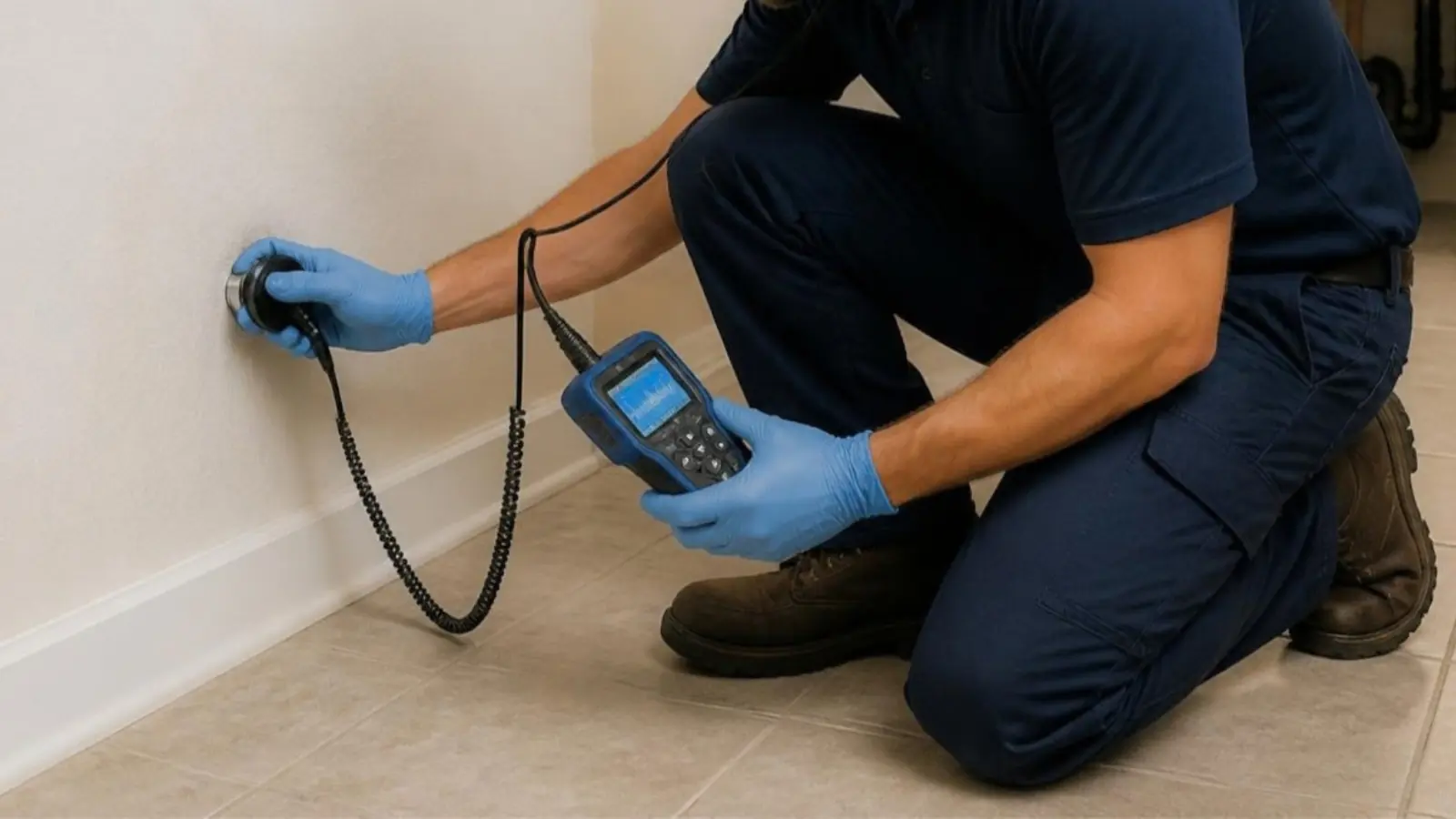
Do not crawl in if the space is flooded, tight or unlit, and do not touch wiring. A leak under the slab or in a wall will not show to the eye at all. Acoustic and thermal equipment is how a plumber pinpoints those without opening the floor. That is where a water service line repair often starts if the leak is outside the house.
Common mistakes
- Running the meter test while the ice maker or a softener is cycling.
- Assuming a high bill must be a bigger family, not a leak.
- Ignoring a toilet that runs for a few seconds every hour.
- Digging in the yard without calling 811.
- Treating a damp spot with a fan and never finding the source.
Fixing the visible symptom and skipping the cause is the costly one. Drywall dries, but the pipe that made it wet keeps leaking until it is repaired.
When to stop and call a plumber
Call when the meter moves with the main closed, when you hear water you cannot trace, when a floor feels warm or spongy, or when mould smell appears with no visible source. A licensed plumber can locate the leak and give you a clear price before work starts.
A slow leak often is not covered by insurance, while sudden damage often is, so read your policy or ask your insurer. Photograph the meter readings and bills. They help any claim and help the plumber find the leak faster.
What affects the cost of finding a hidden leak
Prices vary because leaks vary. These are the factors that move the number.
We state a clear price before work starts.
Mill Creek homes and hidden leaks
Western Washington is wet from fall through spring, which means a damp crawlspace in January is not proof of a pipe leak. Check whether the dampness is from groundwater or from the plumbing by repeating the meter test with the house water off. That saves you from chasing the wrong problem.
Homes built from 1976 through the early 1980s often have original supply lines, and some homes of that era used polybutylene. Ask a plumber to identify your pipe. We also dispatch to nearby towns including Bothell, and the same meter test applies there.
The City of Mill Creek's utilities page lists two water and wastewater providers, Alderwood Water and Wastewater District and Silver Lake Water and Sewer District. Which one serves a given address depends on where the home sits, so check your latest bill or call the provider to confirm. Then ask where its responsibility ends and yours begins.
Hidden leak questions
How much water does a running toilet waste?
A flapper that leaks all day can waste a lot over a month, and you will not hear it. The dye test finds it in fifteen minutes.
Can a leak exist if I see no wet spot?
Yes. Slab leaks, wall leaks and buried service line leaks often show nothing at the surface. The meter test is the first reliable sign.
Is it the meter if the dial keeps moving?
Rarely. A moving dial with everything off almost always means real water use or a leak. Ask your water utility to confirm the meter if you doubt it.
Will my insurance pay for a hidden leak?
Sudden damage is often covered, while slow leaks often are not. Read your policy or ask your insurer, and keep your bills and meter readings.
Can a Mill Creek plumber find a leak without breaking the floor?
Often yes. Acoustic and thermal tools can narrow the leak to a small area first. We cannot promise no opening is needed, but we try to keep it as small as the pipe allows.