
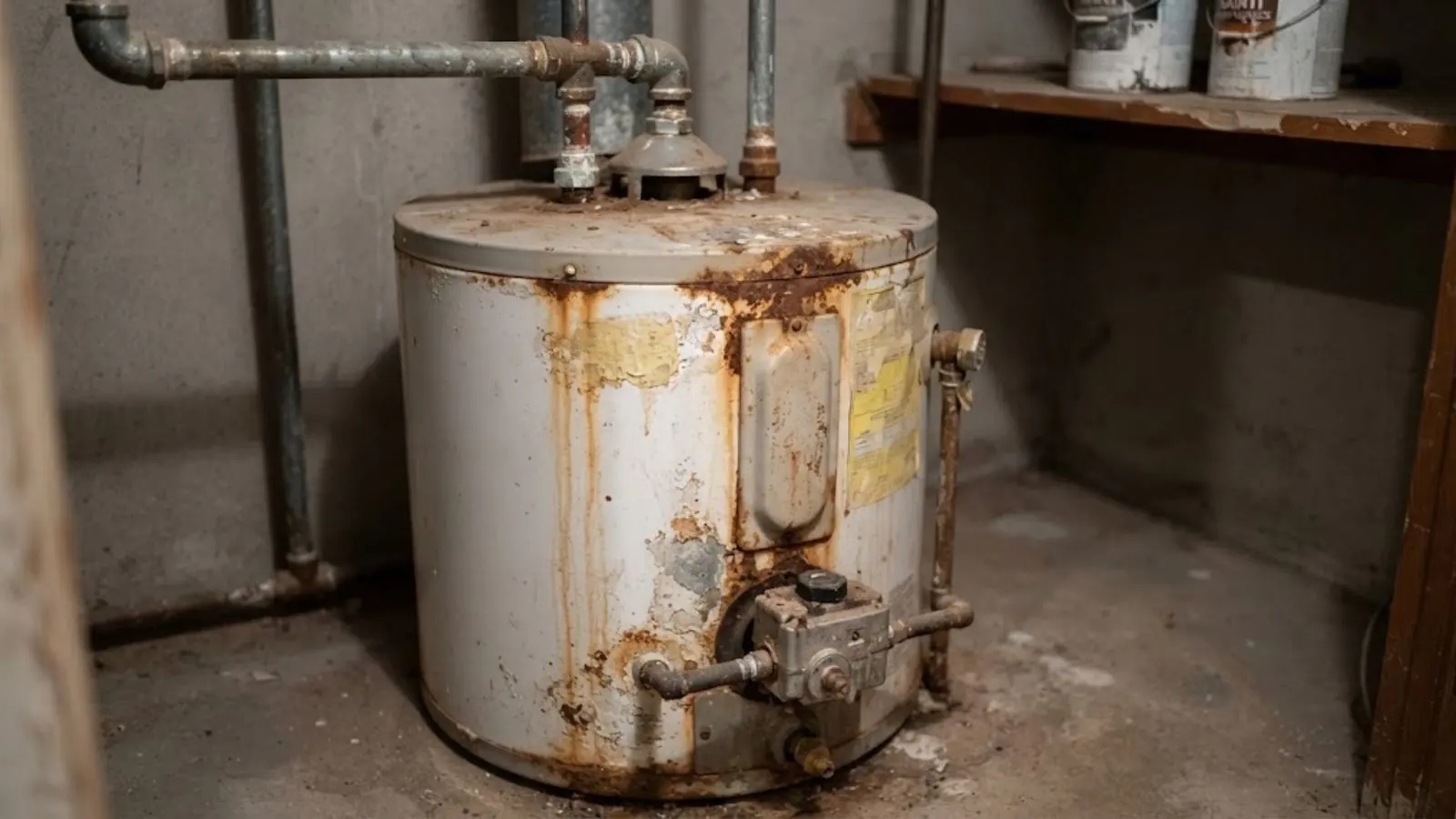
What an anode rod does
A steel water heater tank sits full of water all day, and that water wants to corrode steel. A glass lining covers most of the inside, but it has tiny gaps. The anode rod is a long bar of magnesium or aluminium, usually with a steel core, that hangs from the top of the tank.
Because the rod is more reactive than steel, it corrodes in the tank's place. People call it a sacrificial rod for that reason. Once the rod is eaten down to the core, the tank starts to rust from the inside, and that is the slow road to a leak at the bottom.
Signs the rod is spent
A rod rarely announces itself. Most owners only notice side effects, and those side effects can also come from other faults. Treat the list below as reasons to have it looked at, not as a diagnosis.
- Rusty or brownish hot water that is clear when the cold tap runs.
- A rotten-egg smell from the hot side only.
- Popping, crackling or rumbling noises from the tank as it heats.
- Flakes of white or grey scale in a sink aerator or showerhead.
- A tank that is six years old or more and has never had its rod checked.
The sure check is looking at the rod itself. A plumber drains a few gallons, unscrews the rod, and reads its condition. A rod that is pencil-thin, bent, or showing bare steel for more than a few inches is done.
How the replacement works
- Shut off power or gas. For an electric heater the breaker goes off. For gas the control is set to pilot or off. This is a stop-and-call step if you are unsure, since a 240 volt circuit is not a place to guess.
- Close the cold supply and open a hot tap. That relieves pressure so the tank does not fight the plumber during removal.
- Drain a few gallons. The water level only has to drop below the top of the tank. A hose runs to a floor drain or outside.
- Break the old rod loose. A long breaker bar or an impact wrench on a deep socket does it. Many rods have a hex head on top of the tank, and some sit under the hot outlet fitting.
- Lift it out and read it. The remaining length and the bare core tell us whether the tank is a candidate for more years.
- Fit the new rod. Thread sealant or tape goes on the threads, the rod is tightened by wrench, and the supply is opened to refill. The power is turned back on only after the tank is full.
A typical job takes under an hour when everything cooperates. Most of the time goes to draining and refilling the tank, not to the swap itself.
What makes the job easy or hard
| Situation | What it means | Likely approach |
|---|---|---|
| Tight overhead clearance in a closet or garage | A rod is three to four feet long and needs room to lift straight up | Fit a flexible segmented rod that bends as it comes out |
| Stuck hex head | Years of corrosion lock the threads | Use an impact wrench, heat if needed, and accept some risk of damage to the tank fitting |
| Rod almost gone | The tank may already be rusting inside | Replace the rod and explain the tank's remaining life honestly |
| Tank is old with a leak at the base | A new rod cannot fix a rusted-through tank | Move to a replacement |
| Combination hot outlet and rod | Common on some models and harder to reach | Remove the outlet fitting with care |
Mistakes owners make with anode rods
The first mistake is waiting for a leak and then asking for a rod. By then the steel is usually corroded through, and no rod fixes that. Rods do their best work when swapped before the tank shows rust in the hot water.
The second is forcing a stuck hex head with a standard wrench. The tank wall around the fitting is thin, and a slipped tool can bend a nipple or crack the surrounding area. If the head will not turn with a firm pull, stop and call.
The third is assuming every rod is the same. Magnesium rods protect well but can add a sulphur smell in some water, while aluminium rods last longer but are not the right pick for every home. A plumber can match the rod to what your water does.
What anode rod replacement costs: the factors
We do not print dollar amounts in blog posts, because the tank and the access decide the bill. These are the real cost factors:
- Clearance above the tank, which decides whether a flexible rod is needed.
- Whether the hex head is stuck and needs extra time or tools.
- The type of rod and the length your tank requires.
- The tank size and how long it takes to drain and refill.
- Whether the visit is after hours or on a weekend.
Check the manufacturer warranty before you start. Some warranties expect rod upkeep, and a tank with a rod swapped by the owner may complicate a later claim. You get a clear price before work starts, and we tell you if the money would be better spent elsewhere.
Repair or replace: when the rod is not enough
A fresh rod only makes sense for a tank with a healthy lining. If the heater is more than about ten or twelve years old, shows rust at the base, or has leaked even once, a rod is a bandage. In those cases a water heater replacement costs less over time than repeated visits.
If the tank is in its middle years and the rod is simply used up, a swap is a sensible repair. A technician doing water heater repair can check the rod, the dip tube and the temperature setting in one visit and tell you which path is honest for your unit.
Anode rods in Mill Creek homes
Homes in the original Mill Creek plat were built from 1976 into the early 1980s, and homes of this era often have a water heater that has already been replaced once or twice. Ask when yours was installed. If the answer is longer ago than the rod was ever checked, a rod inspection is a cheap way to find out how much life remains.
Western Washington is earthquake country, so tank heaters are commonly strapped to the wall. That strapping can block the lift space a rod needs. We also dispatch to Bothell and nearby towns, and the same clearance questions come up there.
Anode rod questions
How often should an anode rod be checked?
Many plumbers suggest looking at the rod every few years once the tank is about five years old. Check your manual for the maker's advice, since it varies by model.
Can I replace the rod myself?
It is possible for a handy owner with the right socket and room above the tank, but the gas or 240 volt power must be off and a stuck head is a stop-and-call moment. A broken fitting can turn a small job into a tank replacement.
Will a new rod stop my water from smelling like eggs?
Sometimes. The smell often comes from bacteria reacting with a magnesium rod. Switching rod type or flushing the tank may help, and we can look at it during a visit.
Does a new anode rod fix a leaking tank?
No. A leak at the tank body means the steel has failed, and the only fix is a new tank. A rod protects a tank that is still sound.
How do I know if my Mill Creek water heater is worth saving?
Age, rust at the base and any past leaks are the main clues. In neighbourhoods built in the late 1970s and 1980s, the heater is often a replacement already, so call the 24/7 line and we will check the rod and tell you plainly if the tank has life left.