
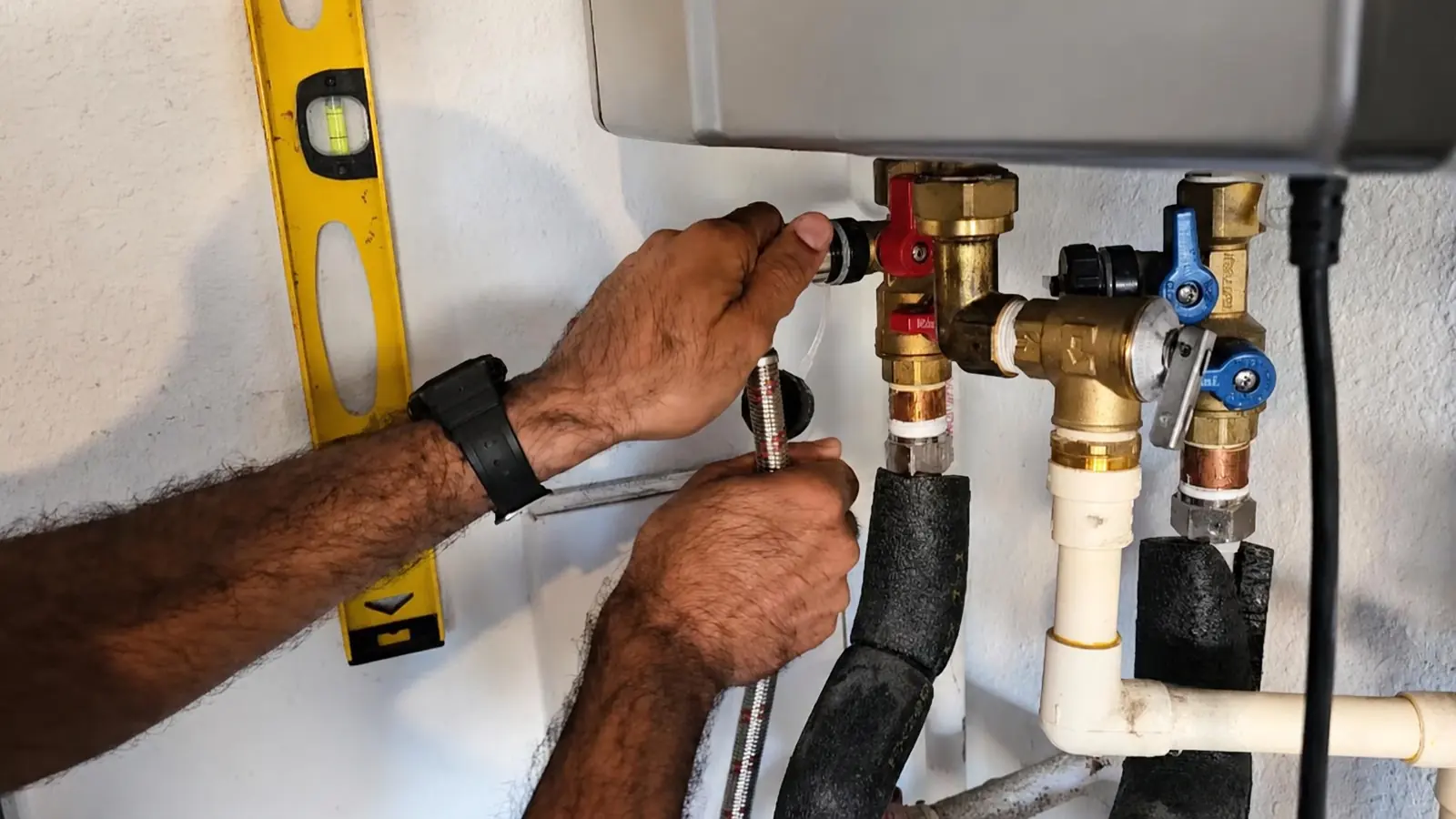
Safety before you check anything
A tankless heater burns gas or draws a heavy electric load, and it vents exhaust gases outside. That mix is not forgiving. If you smell gas, leave the building and call 911 or the gas utility before anything else, then call us.
Never open the cabinet, remove the front panel, or touch any wiring, even with the power off. The checks below all happen from outside the unit, on the wall display, the manual, the shutoff valves and the vent termination. Anything that needs a tool inside is a job for a plumber.
Start with what the symptom tells you
| Symptom | Common causes | First safe check |
|---|---|---|
| Display dark, no hot water | No power, tripped breaker, unit switched off | Look at the breaker panel and the unit's power switch or plug |
| Lit display, but no heat | Gas valve closed, supply interrupted, flow too low | Check the gas shutoff handle and whether other gas appliances work |
| Hot water that goes cold after a minute | Scale, clogged inlet screen, low flow, venting fault | Try one tap at a time and see if it steadies |
| Short burst of cold between hot runs | The cold sandwich effect from a short pause | Wait ten seconds with the tap open before judging |
| Error code showing | Ignition, vent, flow or temperature fault | Find the code in the manual and note it before resetting |
| Water pooling near the unit | Loose fitting, condensate drain blocked, or a leak | Turn off the water at the unit's inlet valve and call |
Check power and gas supply
- Check the breaker. Gas units still need a small electric supply for the fan and controls. Flip a tripped breaker once. If it trips again, do not keep resetting it. Stop and call.
- Check the power switch or plug. Some units sit behind a wall switch that someone has bumped. A dark display points here first.
- Check the gas shutoff handle. A valve handle in line with the pipe is open. A handle across the pipe is closed. If it was off, turn it on slowly and test another gas appliance.
- Check for a gas supply problem. If the stove or furnace is also off, the issue is upstream of the heater. Call the gas utility.
- Look at the water side. Make sure the cold inlet valve and the hot outlet valve are fully open and any isolation valves have not been left closed after past service.
The cold sandwich effect and low flow
The cold sandwich effect is common and often not a fault. You shower, pause for a few seconds, and then restart to find a short slug of cold water before heat returns. Hot water still in the pipes cools down, and the unit needs a moment to relight.
A tankless heater also needs a minimum flow to fire. A trickle from a half-open tap may be too gentle. Open the tap fully and see if the unit lights. If it only fires at high flow, a clogged aerator or a clogged inlet screen is likely the cause.
Reading an error code
Most modern units flash a code when something trips. The code is a clue, not a verdict. Codes differ by brand, so the manual is the only reliable translation. Write the code down before you do anything else, and take a photo of the display for the plumber.
A reset is allowed once, by the method in the manual. If the code returns, the fault is real. Common categories include ignition failure, flame sensing, overheating, vent blockage, and a flow or inlet temperature fault. Do not keep restarting the heater, since repeated failed ignition attempts are not good for the unit.
Inlet screen, condensate drain, venting and scale
Some faults are plumbing, not electrical, and a few have owner-friendly checks. The cold inlet screen catches grit and can clog after any work on the water main. If you are comfortable closing the isolation valves and following the manual, cleaning it is a simple job. If the valves are stuck or you see no screen access, leave it to us.
Condensing units drain acidic water through a small condensate line. If that line kinks or clogs, the unit shuts down for safety, and you may see a drip or a drain-related code. Outside, look at the vent termination. A bird nest, snow, leaves or a blocked intake can trip the unit. Clear only what you can reach safely from the ground.
Scale is the slow culprit. Minerals coat the heat exchanger, reduce flow and heat transfer, and eventually trip a temperature code. Descaling is a flush job done with the right pump and solution. Because scale often goes with a fault, our tankless water heater service looks at both.
Mistakes that turn a small fault into a big one
Resetting again and again is the most common. Every restart tries to ignite gas, and a failing unit can flood the vent with unburned fuel. One reset, then call.
Opening the cabinet is the second. Inside is a gas valve, a burner and a high-voltage board. There are no owner-serviceable parts. And if a warranty is in play, a removed panel can complicate the claim.
The third is blaming the heater when the cause is a mixing valve, a faucet cartridge or a recirculation setting. A plumber can sort that out on the same visit as a water heater repair.
When to stop and call a plumber
- A gas smell, a hissing sound, or a flame outside the burner area.
- A breaker that trips repeatedly.
- An error code that returns after one reset.
- Water leaking from the unit or its fittings.
- Soot or scorch marks around the vent or cabinet.
- Any fault you would need to open the cabinet to confirm.
Tankless heater down right now?
Call the 24/7 line and we will talk through the symptom and book the earliest same-day appointment when available.
Tankless faults in Mill Creek homes
Many tankless units here replaced older tank heaters in homes built in the late 1970s and 1980s, or went into newer construction in East Gateway and The Farm at Mill Creek. Retrofit venting and gas sizing differ between those homes, so faults on a retrofit often trace to the install itself, not the unit.
Cold snaps on some winter nights can freeze exposed condensate lines, and wet-season leaves can foul an outdoor vent. We also dispatch to Bothell and nearby towns for the same faults.
Tankless not working: common questions
Why does my tankless heater give cold water in the middle of a shower?
Often it is the cold sandwich effect, a clogged inlet screen or scale, or a flow that dips below the minimum. If it keeps happening, have the unit checked.
Can I reset my tankless water heater?
Once, using the method in the manual. If the fault code returns, stop and call. Repeated resets stress the ignition system.
Is a tankless heater not working an emergency?
A gas smell is. No hot water is urgent but not dangerous. The 24/7 line takes calls any hour and books same-day appointments when available.
Should I repair or replace a failing tankless heater?
Repair usually makes sense for a unit in its middle years with a single fault. If it is old, scaled up and failing in several ways, replacement can cost less over time.
Do tankless heaters need power if they run on gas?
Yes, a small supply for the fan, display and controls. A power cut stops the heater, so check the breaker and any wall switch early. For a Mill Creek winter outage, plan on no hot water until the power is back.