
Why tankless units need a yearly service
Water carries dissolved minerals. Inside a tankless unit, those minerals bake onto the heat exchanger, the coil that moves heat into the water. A thin layer of scale acts like a blanket, so the burner works harder for the same hot water, and the unit can start to overheat or throw error codes.
Scale builds slowly and silently. Many owners notice the symptoms first: a lower flow of hot water, a longer wait for temperature, or a faint rumble. A yearly flush is cheap insurance against all three. Households that run the unit hard, like a big family with back-to-back showers, may want it more often.
What you need, and an honest note on limits
A proper flush is not just a hose and a bucket. Most units need isolation service valves, three fittings on the water lines that let you close the main flow and open a flush port. If your unit was installed without them, you cannot flush it correctly until a plumber adds them.
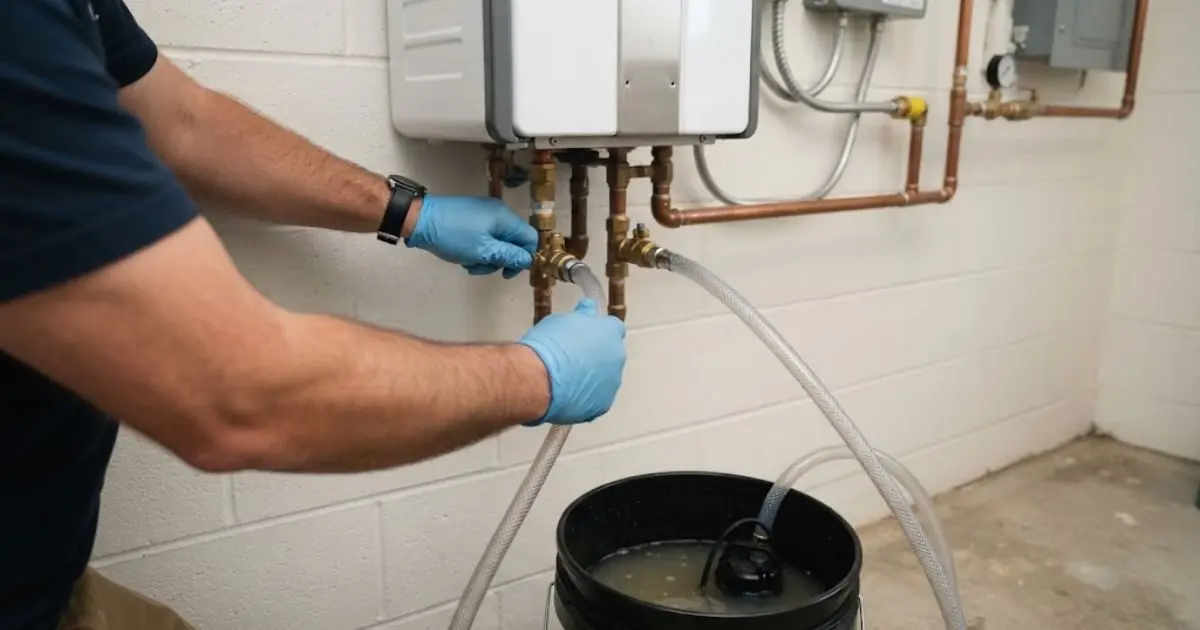
You also need a small submersible pump, two short hoses, a five-gallon bucket, and a descaling solution that your manufacturer approves. Models differ in how they drain, how much solution they take, and whether they need a bypass step. Read your manual first and follow it, not this post, wherever the two disagree.
- Isolation service valves on the hot, cold, and gas or electric lines as the manual calls for
- Pump, two hoses with the right fittings, and a clean bucket
- About 2 to 3 gallons of manufacturer-approved descaler, or white vinegar if your manual allows it
- A soft brush and a small flashlight
- The manual for your exact model, open and within reach
The yearly flush, in outline
These steps are a general outline. Your model may require a different sequence, a bypass setting, or a specific descaler. Check the manual before you begin.
- Shut off power and fuel. Unplug an electric unit or turn off the breaker. For a gas unit, close the gas valve at the appliance. Let the unit cool for about 15 minutes.
- Close the water isolation valves. Turn off the cold and hot service valves so the unit is cut off from the house. Open the pressure relief on the hot side slowly to release pressure into the bucket.
- Connect the hoses. Attach one hose from the pump outlet to the cold-side flush port. Attach the second hose from the hot-side port back to the bucket, so the solution circulates.
- Run the descaler. Pour the solution into the bucket, start the pump, and let it circulate for 45 to 60 minutes, or whatever time your manual calls for.
- Rinse with clean water. Drain the solution, then flush with fresh water for several minutes. Never skip the rinse, because leftover acid is hard on seals.
- Close the ports and reopen the valves. Return every valve to its running position, open a hot tap to purge air, then restore power and fuel.
Inlet screen and filter
Behind the cold water inlet sits a small mesh screen, and many units also have an inline filter. Grit from the main line or a recent pipe job can collect there. When the screen clogs, flow drops and the unit may show an error.
After the water is off and the line is relieved, unscrew the filter housing or pull the screen with the pliers your manual suggests. Rinse it under a tap and brush off the debris. Look for tears. A damaged screen should be replaced, not reused, because it protects the heat exchanger from particles.
A look at the venting
Gas tankless units push exhaust through a sealed vent. With the unit off and cool, look at the pipe from the outside. Check for loose joints, sagging runs, rust stains, and bird nests or debris at the termination. Leaves and wasp nests are common in wooded lots.
Do not take apart venting or touch the combustion chamber. A vent that looks damaged, blocked, or sooty is a safety issue, because exhaust gases can contain carbon monoxide. Keep working CO alarms on every floor, and call for help rather than guess.
When maintenance becomes a repair call
Stop if the unit shows a persistent error after you finish, if you find water leaking inside the cabinet, or if descaler will not circulate. Also stop if you smell gas, in which case leave the building first and call 911 or the gas utility. Never open internal wiring on a tankless unit.
Our licensed plumbers service and install units from the tankless water heater side of the trade and diagnose faults through water heater repair. We give a clear price before work starts, and the 24/7 line takes calls at any hour.
Honest limit: if your unit has no service valves, the first visit may be to add them. That adds to the work, but it makes every future flush quick.
Tankless upkeep in Mill Creek homes
Many Mill Creek homes were built between the late 1970s and about 1983, and plenty of owners have since swapped a tank for a wall-hung tankless unit. A newer addition to an older house sometimes means the vent runs close to trees, so check the termination for needles and leaf litter after fall storms.
Western Washington is wet from fall through spring, so check outdoor vent caps for moss and pooled water too. Cold snaps happen on some winter nights, so also look at any exposed lines near the unit. We also dispatch to nearby towns, including Bothell.
Tankless maintenance questions
How often should a tankless water heater be flushed?
Most manufacturers say once a year. Households with heavy use, or with signs of scale such as reduced flow or odd noises, may flush more often. Your manual gives the interval for your model.
Can I use vinegar instead of descaler?
Some manuals allow white vinegar, and others require their own product. Use only what your manufacturer approves, and always rinse well afterward.
What if my unit has no service valves?
Then it cannot be flushed correctly. A plumber can add isolation valves in one visit, and that work pays off the next time you flush.
Can I do all of this myself?
The filter and screen cleaning is usually simple. The flush is doable with the right valves, a pump, and the manual. Venting issues, gas smells, and any internal wiring are not DIY work.
Can a Mill Creek plumber service my tankless unit if I skipped years of maintenance?
Yes, though the first flush on a neglected unit can take longer and sometimes shows damage already done. Call the 24/7 line, tell us the model, and we will say honestly what is likely to help.